Category Archives: Uncategorized

No; Magazines Are Not Guns

You may recall that a lawsuit was filed by relatives of the Sutherland Springs, Teas, church shooting against the store that sold the rifle to the chumbucket shooter. The theory they used was that the shooter used Colorado ID to purchase the rifle in Texas (legally). He also bought a 30-round magazine unlawful in Colorado. While federal law allows in person long arm sales to out-of-state residents, the sale of the firearm must comply with the laws of both states.

Plaintiffs stupidly argued that “firearm” includes “magazine,” and the store made an unlawful sale. More than two years ago, I rather vehemently disagreed. Sadly, the lower court displayed a level of idiocy on par with plaintiffs and allowed the case to go forward.

Well, it took more than two years — one might think that justice delayed is justice denied, but welcome to America — but the Texas Supreme Court finally weighed in. They slapped them down unanimously.

The lawsuits said that Kelley provided store clerks with a Colorado ID, and the U.S. Gun Control Act required Academy to comply with Colorado gun laws before approving the purchase. Colorado, however, prohibits the sale of magazines holding more than 14 rounds, while Academy sold Kelley a rifle that came packaged with a 30-round magazine.

But the court said the sale was legal because the federal law applies only to the sale of firearms, not components.

Thus, having not acted in a criminal or negligent manner, Academy retains immunity under the Protection of Lawful Commerce in Arms Act. Told you so, “law professor” Lytton.

Here is the actual decision. I found this part of particular interest.

We hold that the underlying lawsuits are qualified civil liability actions that the PLCAA bars as a matter of law. Accordingly, the trial court abused its discretion in denying Academy’s
motion for summary judgment. We further hold that Academy lacks an adequate remedy on appeal. We therefore conditionally grant Academy’s petition for writ of mandamus and direct the trial court to grant Academy’s summary-judgment motion.

“Abused.” Generally, when I see a court overturning a lower court, they say the court “erred,” or was “incorrect.” Abused suggests that the Supreme Court is rather unhappy with that judge. As well they should be.

Hopefully, Academy Sports will now countersue for legal expenses., which I imagine have been substantial. I have no idea whether the plaintiffs will attempt to appeal this to the federal level (where all bets are off on sanity and Second Amendment rights recoginition). Frankly, I was surprised that this was filed in state court rather than federal, given that plaintiffs were attempting to cite federal law.

Facebooktwitterredditpinteresttumblrmail

Sixth Circuit Finds Bump-Fire Stocks Are Not Machine Guns

A three judge panel of the Sixth so ruled, reversing the lower court and remanding the case back to be decided consistent with the finding that they do not meet the definition of “machine gun.”

Importantly, they also ruled that the lower court erred in granting the ATF Chevron deference.

Because an agency’s interpretation of a criminal statute is not entitled to Chevron deference and because the ATF’s Final Rule is not the best interpretation of § 5845(b), we REVERSE the district court’s judgment and REMAND for proceedings consistent with this opinion.

That’s quite proper, because Chevron deference is limited to administrative interpretation of civil matters, and specifically excludes interpretations that inflict criminal penalties.

The meat of the machine gun matter is here.

To initiate bump firing, the shooter pulls the trigger once, firing one shot, while maintaining “constant forward pressure with the non-trigger hand on the barrel-shroud or fore-grip of the rifle.” Id. at 66,516. At the same time, the shooter also maintains constant rearward pressure with his trigger hand, while keeping his trigger finger stationary. The recoil energy from the fired shot causes the firearm to slide backward approximately 1.5 inches. Id. at 66,518. The forward pressure applied by the shooter’s non-trigger hand, along with the recoil energy channeled by the bump stock, causes the firearm to then slide forward. As the firearm slides forward, the trigger “bumps” against the shooter’s stationary trigger finger, causing the trigger to depress and the firearm to shoot again. This second fired shot creates recoil energy once again, which again causes the bump-stock-attached firearm to slide back. The trigger is released and reset, and the process repeats.

And they take note of the way the ATF keeps changing its collective alleged mind (my phrasing, not theirs).

In 2006, the ATF opened an investigation and, by its own admission, “overruled” its previous decision that the Akins Accelerator was not a machine gun. Final Rule, 83 Fed. Reg. at 66,517. The Agency concluded that the Accelerator’s internal spring made the device a machine gun, but stated that if Accelerator owners removed the internal spring from the device, then it “would render the device a non-machinegun under the statutory definition.” Id. Akins sued, arguing that the Agency’s reversal was unreasonable, that the reversal violated due process, and that the statutory definition of machine gun was unconstitutionally vague.

This is a major win for freedom and rights. But it’s one Circuit, and it’s likely to be appealed to SCOTUS. And I trust them about as far as I can throw their building. With one hand.

Facebooktwitterredditpinteresttumblrmail

“Brian A. Terry Memorial Eliminate the ATF Act”

Marjorie Taylor Greene [R-GA14] continues to endear herself to me, while driving the Dims nuts. Today, she’s going to introduce the Brian A. Terry Memorial Eliminate the ATF Act. Brian Terry, I hope you recall, was the Border Patrol Agent murdered by illegals armed with a gun that the ATF willfully allowed to be unlawfully trafficked across the border.

Amusingly, it begins with:


All regulations and guidance issued by the Bureau of Alcohol, Tobacco, Firearms, and Explosives during the period that begins with August 1, 2020, and ends with the date of the enactment of this title are hereby null and void and shall have no force or effect.

That would include:

I would have set the start date at December 1, 2018 and included the bump-fire stock rule.

I also love the part where employees of the ATF as of the date of abolishment of the agency are terminated. Not reassigned. Fired. The feddies’ union would go nuts.

Sadly, between the Dim-crat control of the House, government inertia, and the fact that this is coming from MTG guarantees it’ll go nowhere. But I still like it.

If you found this post useful, please consider dropping something in my tip jar. I could really use the money, what with ISP bills, rabbit feed, and general life expenses.Click here to donate via PayPal.
Facebooktwitterredditpinteresttumblrmail

ATF Rule-Making Irony

Caution: Chimps At Work

I wrote last week about the ATF not properly following the Administrative Procedures Act; to wit: they published the NPRM on one docket, took comments, then killed that docket and opened a new one. Let’s follow up on that.

I submitted comments on behalf of myself and The Zelman Partisans on the original docket. When the docket disappeared, I resubmitted both on the new docket. I then decided to document the ATF’s APA failure for posterity and submitted a third personal comment criticizing the failure.

As with the previous attempt at rule-making on bump-fire stocks, I see the ATF has once again published the “Definition of Frame or Receiver and Identification of Firearms” under ome docket number, then killed that docket after comments were submitted. And then published again under a new docket number sans old comments.

I do not think that an agency too incompetent to follow the Administrative Procedure Act has any business attempting to unconstitutionally override Cnngress on technical definitions.

I checked comment status today. One of the TZP comments finally posted today: koy-csz4-nwkx

And one of my personal comments was posted today. Ironically, it was the third one; the APA critique.

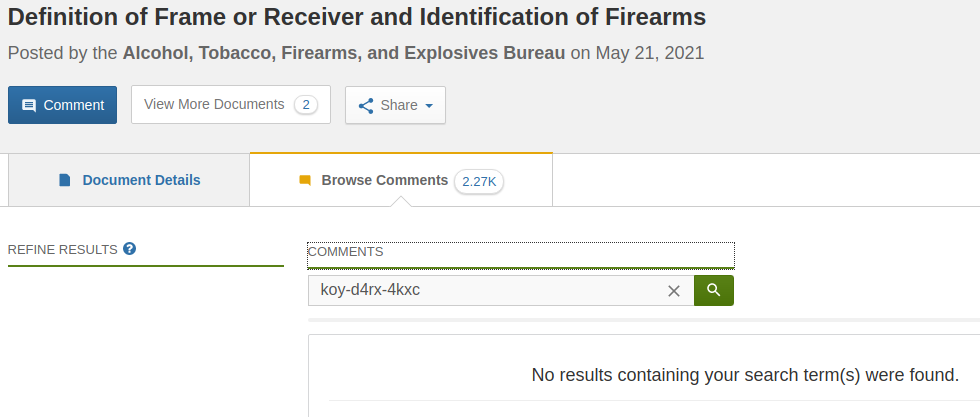
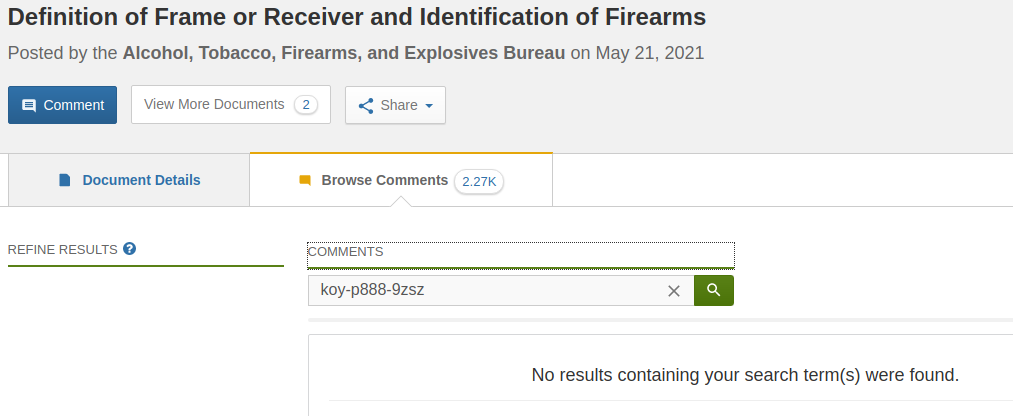
koy-d4rx-4kxc and koy-p888-9zsz, submitted well before the critique, are still missing in action.

I think that’s an interesting highlighting — by the ATF — of the very problem.

But what can we expect of bureaucratic Bonzos who are still trying to figure out the whole firearm thing? Struggling with 19th century technology, they can hardly be expected to grasp electronic communications and databases.

Facebooktwitterredditpinteresttumblrmail

ATF: Rule-Making Muck-Ups

Remember when the ATF screwed around with the NPRM and commenting process on its bump-fire stock ban rule?

They’re doing again, with the new definitions of “firearm,” “frame, and “receiver.”

The original URL for the NPRM went dead sometime today. I discovered this when I checked to see if TZP’s or my own comments were visible yet. It’s gone.

The new page is Definition of Frame or Receiver and Identification of Firearms, and the docket number is no longer “ATF 2021R-05;” it is now “Docket (ATF-2021-0001).” You can comment HERE, which I’ll need to do again because our comments on the previous version are gone (a search of the tracking number I was given returns nothing).

You’d think that by now the ATF could figure out the whole Administrative Procedures Act thing. But then, they still haven’t figured out “firearm” in decades.


See an ironic update.

Facebooktwitterredditpinteresttumblrmail

[UPDATE] NPRM: “Definition of Frame or Receiver and Identification of Firearms”

The Notice of Proposed Rule-Making has finally been published.

You can — and should — COMMENT HERE. Commenting closes on August 19, 2021. Please let the ATF know what you think of the disastrous attempt to override Congress.


Update, 5/21/2021,3PM EDT:
The original URL for the NPRM went dead sometime today. I discovered this when I checked to see if TZP’s or my own comments were visible yet. It’s gone.

The new page is Definition of Frame or Receiver and Identification of Firearms, and the docket number is no longer “ATF 2021R-05;” it is now “Docket (ATF-2021-0001).” You can comment HERE, which I’ll need to do again because our comments on the previous version are gone (a search of the tracking number I was given returns nothing).


The Zelman Partisans have submitted this comment:


COMMENT
Tracking Number: koy-csz4-nwkx

The ATF takes note of the fact that existing law, as written and passed by Congress, does not define “firearm” to include many types of implements including AR-pattern arms with separate upper and lower “receivers,” (split-frame) semiautomatic handguns with separate slides and “frames,” or striker-fired implements. The Notice of Proposed Rule-Making pretends that these are recent innovations that Congress could not have envisioned, and thus the ATF must broaden the language of the law to catch up.

1895: Marconi’s radio experiment

1902: First commercially successful radio transmission system

1910: Wireless Ship Act

It only took Congress 8 years to take notice of the new technology. Two years later, Congress passed the Radio Act of 1912; ten years after the first successful commercial system.

In 1927, 25 years — just a quarter century — after Marconi’s FIRST commercial system, Congress chose to greatly expand regulation of the evolving technology.It only took 32 years from Marconi’s radio EXPERIMENT for Congress to join an international treaty on the regulation of radio transmission.

Yet the ATF would have us believe that Congress simply didn’t know about the existence of striker-fired guns for 60 years prior to the passage of the National Firearms Act of 1934. That Congress didn’t know about the existence of split-frame guns like the Browning Model 1911 adopted by the US Army decades before the NFA.

The ATF would have us believe that by 1968, Congress STILL had no clue that striker-fired guns had existed for a century, or that there was such a thing as split-frame semiautomatic handguns since Browning’s design of the M1900 in 1896; 72 YEARS before. That Congress had no idea they’d authorized funds for the US Army to purchase and issue split-frame M16s four years before.

Congress has shown the ability to note and regulate new technologies at less than a glacial pace. But despite THESE devices existing for well over a century, Congress has chosen not to include them in the definition of firearm. We must, then, conclude that Congress saw no need to regulate them, and that ATF doing so violates the intent of Congress.

COMMENT END


Facebooktwitterredditpinteresttumblrmail

Commenting on the ATF’s NPRM Redefining “Firearm”

I’ve gone over the alleged — but not publishedNotice of Proposed Rule-Making. While this version clearly shows lineage with the earlier leaked draft, some of the more psychotic elements are gone, but replaced with vague, arbitrary arrogations of Congressional authority. It’s almost as if they read my remarks on their draft.

The ATF gives the docket number for this as “ATF 2021R-05.” When this finally appears on Regulations.gov, I intend to file the following comment.


COMMENT

The ATF takes note of the fact that existing law, as written and passed by Congress, does not define “firearm” to include many types of implements including AR-pattern arms with separate upper and lower “receivers,” (split-frame) semiautomatic handguns with separate slides and “frames,” or striker-fired implements. The Notice of Proposed Rule-Making pretends that these are recent innovations that Congress could not have envisioned, and thus the ATF must broaden the language of the law to catch up. I have multiple objections to this.

1. Congress still exists. If Congress, that branch of government constitutionally charged with crafting law, wants a more encompassing definition, it may do so at any time. Congress has had 87 years since the National Firearms Act of 1934, and 5 years since the Gun Control Act of 1968, to broaden the definition. Yet, it has found no need to do so.

2. In fact, striker-fired firearms predated the NFA by 56 years. And it seems odd that the ATF doesn’t appear to know about the existence of the Browning 1911 split-framed pistol. Or the Browning Hi-Power patented in 1923. Such arms existed for decades before Congress chose in 1934 to regulate and tax certain types, yet Congress chose NOT to regulate and tax those that the ATF suddenly finds so troubling. The split-framed AR-15 that confuses the ATF was produced in 1959, and the US military began adopting its fully automatic — and likewise split-framed — cousin in 1964; yet Congress still chose not to include the technology in the later GCA.

3. As the NPRM notes, Courts have been finding for years that split-frame arms are not “firearms” under the law. And yet, still, Congress has chosen not to include them as firearms for regulatory and tax purposes.

4. The ATF is attempting to CHANGE statutory law as written and passed by Congress, not merely clarify definitions. That exceeds the ATF’s scope of authority and arrogates powers constitutionally delegated to Congress alone.

I object more specifically in particular areas.

I. “A. Definition of “Firearm”

“Therefore, to reflect existing case law, this proposed rule would add a sentence at the end of the definition of “firearm” in 27 CFR 478.11 providing that “[t]he term shall include a weapon parts kit that is designed to or may readily be assembled, completed, converted, or restored to expel a projectile by the action of an explosive.””

This adds a definition not in statutory law as written and passed by Congress. That exceeds the ATF’s scope of authority and arrogates powers constitutionally delegated to Congress alone. I find myself repeating that constitutional point that seems to have escaped the ATF. You propose defining inert paperweights as firearms. I suspect the use of recreational pharmaceuticals.

II. “B. Definition of “Frame or Receiver”

1. General definition of “frame or receiver”
Next, the new definition more broadly describes a “frame or receiver” as one that provides housing or a structure designed to hold or integrate any fire control component. Unlike the prior definitions of “frame or receiver” that were rigidly tied to three specific fire control components (i.e., those necessary for the firearm to initiate or complete the firing sequence), the new regulatory definition is intended to be general enough to encompass changes in technology and parts terminology.”

This alters a definition in statutory law as written and passed by Congress. That exceeds the ATF’s scope of authority and arrogates powers constitutionally delegated to Congress alone.

III. “2. Firearm muffler or silencer frame or receiver

Under the NPRM, the term “frame or receiver” means, “in the case of a firearm muffler or firearm silencer, a part of the firearm that, when the complete device is assembled, is visible from the exterior and provides housing or a structure, such as an outer tube or modular piece, designed to hold or integrate one or more essential internal components of the device, including any of the following: baffles, baffling material, or expansion chamber.””

Classifying the WHOLE as the silencer makes some sense. But that logic is exactly the opposite of that used to define PARTS of frames or receivers as a firearms in and of themselves. Thus the ATF once again display its tendency towards seemingly drug-addled inconsistency.

IV. “3. Split or modular frame or receiver

This second supplement explains that ATF may determine “in the case of a firearm with more than one part that provides housing or a structure designed to hold or integrate one or more fire control or essential components” whether one or more specific part(s) of a weapon is the frame or receiver…”

That is not a definition; it is a declaration that “We’ll know it when we see it, but won’t offer a real definition;” yet you give yourselves the alleged authority to declare a part of firearm to be a firearm, and your determination cannot be overruled by the Courts. That exceeds the ATF’s scope of authority and arrogates powers constitutionally delegated to Congress AND to the Courts.

V. “C. Definition of “Readily”

To provide guidance on how the term “readily” is used to classify firearms, including frame or receiver parts kits or weapon parts kits sold with incomplete or unassembled frames or receivers, the NPRM adds this term to 27 CFR 478.11 and 479.11 and defined as “a process that is fairly or reasonably efficient, quick, and easy, but not necessarily the most efficient, speedy, or easy process.” It would further list factors relevant in making this determining to include:”

That’s not a definition; that is a list of seven tests with no stated threshold for any of them. Specific thresholds for each must be stated, or it’s just another vague, “Close enough; we know when we see it; we just can’t describe it.” The question of recreational pharmaceuticals comes to mind again. Or perhaps medication is NEEDED.

In citing United States v. Seven Miscellaneous Firearms, 503 F. Supp. 565, 574–75 (D.D.C. 1980) as a cut-off, anything that requires less than a master gunsmith in a shop with $65,000 worth of tools and equipment would be “readily converted.

I suggest that a better definition would be: ” ‘Readily converted’ shall mean that the combined costs of completion including parts, materials, tools and equipment, and labor time figured at the federal minimum wage is less than the retail price of a comparative commercially produced firearm. For example, a privately manufactured AR-pattern firearm would be compared to a commercial model such as a JP Rifles SRC-11. A polymer type PMF AR-pattern rifle would be compared to the polymer-“framed” American Tactical Omni Hybrid.

If one must purchase a $2,120 Ghost Gunner 3 to build a $500 AR-pattern rifle, the PMF kit is not “readily converted” to a firearm. A $100 kit completed with a $200 drill press and another $200 worth of hand tools and eight hours of time (combined total $558) to make a $300 handgun is not “readily converted.”

In summary: This proposed rule would arrogate the powers of Congress and the Courts in order to arbitrarily change statutory law. It would regulate PARTS as firearms when Congress itself spent decades choosing to NOT do so. It unnecessarily complicates the issue of what is and is not a firearm, an unduly burdens builders both licensed and private with Byzantine regulations and definitions STILL changeable upon ATF whim. It takes the power of Courts to read the written law and apply it to real world from them, and endows the power upon the ATF bureaucracy.

Rather than engage in this drug-induced rights infringement, I proposed that, in the spirit of “shall not be INFRINGED,” The National Firearms Act of 1934, Gun Control Act of 1968, and all firearm regulations be repealed, and the Bureau of Alcohol, Tobacco, Firearms, and Explosives be permanently disbanded. All former ATF employees should be investigated for civil rights violations under 18 U.S. Code § 242 – Deprivation of rights under color of law.

“Whoever, under color of any law, statute, ordinance, regulation, or custom, willfully subjects any person in any State, Territory, Commonwealth, Possession, or District to the deprivation of any rights, privileges, or immunities secured or protected by the Constitution or laws of the United States, or to different punishments, pains, or penalties, on account of such person being an alien, or by reason of his color, or race, than are prescribed for the punishment of citizens, shall be fined under this title or imprisoned not more than one year, or both; and if bodily injury results from the acts committed in violation of this section or if such acts include the use, attempted use, or threatened use of a dangerous weapon, explosives, or fire, shall be fined under this title or imprisoned not more than ten years, or both; and if death results from the acts committed in violation of this section or if such acts include kidnapping or an attempt to kidnap, aggravated sexual abuse, or an attempt to commit aggravated sexual abuse, or an attempt to kill, shall be fined under this title, or imprisoned for any term of years or for life, or both, or may be sentenced to death.”

END COMMENT


This column originally appeared at Bear Bussjaeger’s Blog. Used with permission.

Facebooktwitterredditpinteresttumblrmail

The ATF’s Notice of Proposed Rule-Making on Firearm Redefinition Has Been “Published”

The Department of Justice “issued a notice of proposed rulemaking” on Friday afternoon — but of course, when few will notice. This is the one TZP recently warned was coming.

Except.. not really. It has not been published in the Federal Register/Regulations.gov as of 5/7/2021, 5:00PM ET. A search on neither “firearm” nor docket No. “ATF 2021R-05” returns any docket. Therefore, despite the DOJ’s claim, commenting online is not possible yet.

You may download a copy of what the ATF purports to be the NPRM from their website. I have done so, and will analyze it to see where and how it differs from the leaked draft I previously picked apart.

It’s unlikely I’ll make much headway before sunset, so check back here on Sunday or Monday for my analysis.

Facebooktwitterredditpinteresttumblrmail

Analysis Of “Definition of “Frame or Receiver” and Identification of Firearms”

A draft Notice of Proposed Rule-Making covering “unfinished frames/receivers are guns” has leaked. It turns out to be far more than just “ghost guns.” Included is the very definition of firearm, firearm parts (if it sorta looks like ot could made into a part, it is the part), frames, receivers, silencers, gunsmith, and more.

You can find an analysis of the draft NPRM, in the form of a formal comment to be submitted when the final is published here; Analysis: “Definition of “Frame or Receiver” and Identification of Firearms”.

Yes, these remarks will be included.

Is there anyone in the ATF with two functional brain cells?

I suspect the use of recreational pharmaceuticals.

The question of recreational pharmaceuticals comes to mind again. Or perhaps medication is NEEDED.

To summarize, I oppose this irrational, and sometimes self-conflicting rule.

Believe me, those cracks were called for.

Facebooktwitterredditpinteresttumblrmail