
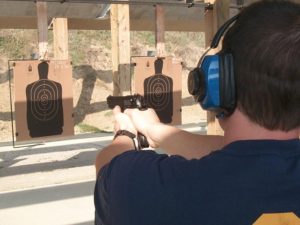
In basic, the first thing we did was familiarize ourselves with our M16A2 rifle. They had us take those things apart and put them together so many times, I could have done it in my sleep! It was useful knowledge. By the time we got to the range for the first time, I was so comfortable with that rifle, I could have slept with it.
But we still didn’t fire the thing. We dry fired. A lot. The drill instructors had us put a penny on the front sight, and we practiced pulling the trigger in the prone position so smoothly, that the penny would not fall off. We had to pull that trigger 10 times in a row without the penny falling off the sight. If it fell, we had to start over.
We spent a lot of time in the dirt in the prone position.
The drills worked. I qualified Expert – 39/40 – at the pop-up range at Fort Jackson thanks to the training we received.
So what about you? What training do you find most useful when it comes to firearms?
The choices below are in no particular order, and I’m sure there are scores of others you can name. Choose one, or let us know in the comments what firearms training you find the most useful.


I find most of the “training” offered for/by police and military to be counterproductive for regular folks who want to learn self defense. Police and military have very different goals and methods, much of it aggressive, offensive rather than defensive. Much of it is plain dangerous for most people to even attempt to use in real life situations.
I’ve studied both, I use some elements of many different approaches, but over the years I’ve come to believe absolutely that the gun, and the technical “perfections” much of this training involves, is pretty much beside the point for most of us. The gun is, MAYBE, 10% of what is needed for effective self defense. Mindset to survive, willingness to do what is necessary to survive, and avoidance of confrontation whenever possible – by being aware of surroundings and not taking unnecessary chances. These are absolutely vital – and carrying a gun can’t compensate for the lack of those attitudes. Becoming careless or overconfident just because one carries a gun could easily become fatal… Just remember that most defensive gun uses in the country are not by trained “ninjas,” but by ordinary folk who usually don’t even fire the gun. Some have never “trained,” and a few never used a gun before. Think of that one…
Train your mind and spirit first, then gain a good grip on the basics of gun (and other tool) handling. Keep your head, and recognize your limitations. You are not a “Navy Seal,” no matter how many you might train with. And their aggressive actions and ideas might just get you killed, or jailed.
Keep it simple. Practice what you truly might need. Do some serious thinking about what that might be, and yes, seek some experienced and effective people to learn more from. IF that then involves “cop” instructors, be very sure just what it is you want from that…
My training follows Mama Liberty, in that I try to keep my mind focused at all times, even when I can’t carry, like at work. I would love to do the fun, high quality schools, but they are too expensive and I can’t see the need for much of the room clearing, etc
Every sort of training is good training, but the most memorable single piece of effective training I ever received – which I practice still – is dry firing.
By the time I went to my first official handgun training class I had developed a comically bad flinch with my 1911, of which I wasn’t even aware. The instructor kept telling me I was flinching, and I kept insisting I wasn’t. He stood behind me and made me hand him my empty pistol. He loaded one round, handed it over my shoulder, and had me fire it. After five or ten times, when he was sure I was convinced the pistol was loaded, he handed it to me unloaded. I was flinching so bad I nearly landed on my face when the gun didn’t go off.
That’s when he got me to dry firing over and over to imprint the way everything feels just as the trigger breaks and to set the muscle memory for how to get through that point without the front sight wavering at all. “Once you’ve got that,” he said, “Just fire every time as if the gun is unloaded.” I did that, my flinch never came back, and I finally began to progress.
That was – oh, goodness – sometime in the late-middle seventies.
The big problem there is that it’s just as easy to “dry fire” practice a seriously bad habit, and make it terribly difficult to change that practice later… I urge all my students to dry fire, of course. I simply caution them to verify what they are practicing that way frequently at the range and, if necessary, with an instructor.
Now that doesn’t mean I’m perfect, or that any other instructor is infallible, of course. 🙂 It’s just that we tend to be very careful what we practice, so we’re not teaching serious bad habits. Trust, but verify!
Just don’t do 10,000 repetitions of something unless you are very sure it is actually what you need to be doing.
Firearm training is another area of life-long learning. It’s not a destination, it’s a journey. Techniques change, equipment and firearms change, and laws change… and the individual must keep current. When it comes to high-dollar schools, yes they are expensive, but they are not all just about HSLD gun manipulation. Taking a class like Massad Ayoob’s MAG-40 will teach you how to shoot better, when to shoot, what to say (and NOT say) to the police, and how to defend yourself if you end up in court. Lawyers take it as an accredited CLE class. For a five day class it will cost you about as much as two hours for a good criminal defense attorney. Isn’t it better to spend the money on a class and avoid the attorney?
“What have you found to be the most effective firearms training?”
Did you mean beneficial?
The best training?
Depends on what you are training for I reckon.
If it’s to defend yourself from someone breaking into your home then I think practice (& instruction) on a square range is good, it should teach you safety, gun handling, trigger control, etc. Things that are the very basis of being proficient with a weapon, putting it in the black and having the confidence you can. Of course once you know what you are doing dry fire practice is the cheapest way to practice. However find pistols & long guns have their special needs and to me a pistol is mainly a defensive weapon, it’s like the saying don’t bring a knife to a gun fight, well I wouldn’t only bring a pistol to a gun fight either if I knew I was going to be in a gun fight.
As ML said, we can’t all be Navy seals, and that’s for sure, for the vast majority of us becoming a navy seal is about as possible as becoming an astronaut or cosmonaut.
But what do you train for? Being a sniper on your hill (which I am not a big fan of for survival if that is all you got but is something that is very useful in a team situation), being able to hold your hill with your neighbor (s), shooting something that is evil coming thru your doorway? All of them start with learning to be safe, proficient and able to hit the black but some will require learning how to work as a team with your neighbors and friends, and when you start learning to work with others, the best place to learn that may start on a square range but it should end up with learning close quarter combat technics in the woods or in buildings, learning how to communicate & move, how to give your buddy cover, then learning how to depend on others to give you cover. Working as a team whether it is of 2 or as many more as might be in your tribe.
You don’t have to be Rambo to learn how to survive in a SHTF situation but if you do want to survive a SHTF situation IMHO doing it without someone(s) on your back is going to be a lot harder (surviving) than having those you can work with and count on.
Even if you don’t have those people today, you may have them tomorrow and you knowing something about Close Quarter Combat might just come in handy for your new found tribe too.