Among other gadgets which the ATF-Troop unilaterally declared to be NFA items — machine guns, specifically — was the forced reset trigger and like items.
Having considered the above-referenced filings and applicable law, th4e Court concludes thatthe Defendants engaged in unlawful agency action taken in excess of their authority. Therefore, the Courts GRANTS Plaintiffs’ Motion for Summary Judgement and DENIES Defendants’ Cross-Motion for Summary Judgement.
Note: The judge didn’t say the ATF exceeded its authority and leave it at that. He specifically and explicitly stated that they acted unlawfully; they broke the law. And he called out their BS on claiming FTRs turn semiautos into machine guns.
An FTR is a device that forcibly returns the trigger to its reset state. In the commercialized FRT designs at issue in this litigation, the trigger is forcibly reset by the hammer when the bolt carrier cycles to the rear. A “locking bar” mechanically locks the trigger in its reset state, preventing the user from moving the trigger rearward to function by releasing the hammer, until the bolt has returned to the in-battery position and the firearm is safe to fire.
[…]
When firing multiple shots using an FRT, the trigger must still rest after each round is fired and must separately function to release the hammer by moving far enough to the rear in order to fire the next round.
TL;DR: It’s still firing semi-auto, idiots. And you don’t get to change the definition of machine gun to encompass whatever.
Plaintiffs’ cgun definition as applied to FRTs ontend that the ATF’s broadened view of the machinegun definition as applied to FRTs is an unlawful expansion of the agency’s authority.Plaintiffs are correct.
Interestingly, there seems to be no mention of CHEVRON deference to agency interpretations, or Loper Bright‘s reversal of such deference. The judge simply noted that both plaintiffs and defendants agreed of how FTRs work, but that the ATF improperly called semiautos machine guns.
Oh, boy. Last week, we saw “CHEVRON deference” overturned, eliminating the ATF-abused procedure of requiring judges to take the agency’s word for it when they creatively reinterpret laws.
Today, the Supreme Court took it quite a bit further in CORNER POST. This is a case over debit card merchant transaction fees, so you wonder what it has to do with Second Amendment issues.
Everything. And the EPA is going to hate this, too. Here’s the background.
In 2021, Corner Post joined a suit brought against the Board under the Administrative Procedure Act (APA). The complaint challenged Regulation II on the ground that it allows higher interchange fees than the statute permits. The District Court dismissed the suit as time-barred under 28 U. S. C. §2401(a), the default six-year statute of limitations applicable to suits against the United States. The Eighth Circuit affirmed.
The lower courts held that the statute of limitations clock started ticking the rule was published. An interesting take; imagine claiming that statute of limitations for robbery started running when the law was passed, rather than when the robbery took place.
That matters, because Corner Post didn’t exist when the transaction fee rule was published. Just like you might not have been born when the armed robbery law pass enacted. Corner post was injured when they opened for business and started accepting debit cards. That is when the statute of limitations starts counting down.
Held: An APA claim does not accrue for purposes of §2401(a)’s 6-year statute of limitations until the plaintiff is injured by final agency action.
How does that apply to us and the ATF?
Until 1982, semi-auto firearms that fired from the open bolt were semi-autos. But that year, the ATF suddenly decided that open-bolt firearms are easily converted into machineguns, and thus are machineguns. Unless…
To make it worse, it only applied to those models sold after the ruling, while those sold prior somehow remain semiautomatic. This forced complete redesigns on the manufacturers.
Here we have a rule that is arbitrary, capricious, and in conflict with the law defining “machinegun.”
The term “machinegun” means any weapon which shoots, is designed to shoot, or can be readily restored to shoot, automatically more than one shot, without manual reloading, by a single function of the trigger.
“Restored,” not converted. It had to be a machinegun at some earlier point in its existence. But courts defer to the ATF’s re-definition, and send people to prison over semi-auto “machineguns.”
We got rid of that stupid deference last week. But it still looked like we were stuck with existing stupid, arbitrary, and capricious rules. No more.
Go out and buy one of those open-bolt SM10 machineguns. When you’re told to apply for your tax stamp, sue the ATF over the idiotic rule…
…because you were just now injured by it. And have standing.
tick tick tick tick tick
Every swamp agency’s years-old rules are now ripe for challenging all over again, without deference. I saw a comment at SCOTUSblog to the effect that SCOTUS just guaranteed itself horrendously full dockets for next few years.
Held: The Administrative Procedure Act requires courts to exercise their independent judgment in deciding whether an agency has acted within its statutory authority, and courts may not defer to an agency interpretation of the law simply because a statute is ambiguous; Chevron is overruled.
When SCOTUS tossed the ATF’s unconstitutional bump-stock ban, they called out the ATF for attempting to take the legislative power of Congress. I thought it was a good start, and I looked forward to the Loper Bright ruling.
This decision doesn’t specifically mention “Cheveron deference” (the idea that courts should defer to a federal agency’s interpretation of a law over that of the challenger), but they certainly did not give the ATF deference here. So that’s a good precedent for gun owners challenging other ATF abuses.
The ATF lives for CHEVRON deference. That’s how two copies of the exact same model of semiauto pistol could be a semiauto, while one assembled the very next day is a machinegun. Or 37 mm projectiles are either not destructive devices (loaded with a black powder pyrotechnic charge) or are destructive devices (loaded with a bean bag). Or the magical way Desert Eagle .50s became destructive devices when they changed the method of measuring the bore. Or…
For too long, the ATF has relied on Just take our word for it, Your Honor. No more; now they have to prove their psychotic re-interpretations really are Congressional intent. And presumed innocence returns.
On the downside, just as has happened post-BRUEN, it’s going to take a lot of effort to get lower courts to pay attention, and stop granting unconstitutional deference to unelected DC swampcrawlers.
I hope the good attorneys at the Firearms Policy Coalition take a look at this decision and that white paper, and see if they can right some very old wrongs.
UNITED STATES v. RAHIMI is in the news with a Supreme Court ruling a few days ago. And the victim disarmament crowd is all over it.
You see, SCOTUS found that someone never convicted of a crime can still lose his Second Amendment rights via a domestic violent prevention order. Associate Justice Thomas dissented. For very good reasons.
Michigan’s Attorney General is one of the people eyeing this ruling with glee.
Rahimi was charged with unlawful firearm possession under 18 U.S. Code § 922(g)(8). An important part of that is this:
(A) was issued after a hearing of which such person received actual notice, and at which such person had an opportunity to participate;
That’s a problem with Michigan’s ERPO law (“red flag”). Michigan’s law allows ex parte proceedings in which the accused does not receive “actual notice, and at which such person had an opportunity to participate.”
So, no, RAHIMI does not support your unconstitutional “red flag” law.
A lower court had dismissed the charge against Rahimi, based on the BRUEN test of general, historical legal tradition; the court found no early laws analogous to firearm possession bans via protective order. But — compromised? — Chief Justice Roberts, writing for the majority, claims to have found not one, but two such laws.
By the 1700s and early 1800s, though, two distinct legal regimes had developed that specifically addressed firearms violence: the surety laws and the “going armed” laws. Surety laws were a form of “preventive justice,” 4 W. Blackstone, Commentaries on the Laws of England 251 (10th ed. 1787), which authorized magistrates to require individuals suspected of future misbehavior to post a bond
[…]
Surety laws could be invoked to prevent all forms of violence, including spousal abuse, and also targeted the misuse of firearms.
Can you spot the subtle difference between a surety bond to prevent a person performing an actual violent act, and a protective order that bans possession of a tool regardless of whether it was used?
Dolly-influenced(?) Roberts couldn’t.
His other example law similarly misses the mark.
The “going armed” laws—a particular subset of the ancient common law prohibition on affrays, or fighting in public provided a mechanism for punishing those who had menaced others with firearms. Under these laws, individuals were prohibited from “riding or going armed, with dangerous or unusual weapons, [to] terrify[ ] the good people of the land.”
The “going armed” laws were specific to threatening and menacing actions using guns (and other weapons), not the simple possession of those implements.
Roberts missed it by this ……………….. […] ………………….. much. I’m not sure how he missed it, since I figured it out two years ago. Yes, I examined historical surety bonds and such in this very light. Maybe the Fifth Circuit read it, even if Roberts didn’t.
Thomas, dissenting, gets it right, as usual.
To trigger §922(g)(8)’s prohibition, a restraining must bear three characteristics. First, the order issues after a hearing where the accused “received actual notice” and had “an opportunity to participate.”
No ex parte proceedings allowed.
Just as important as §922(g)(8)’s express terms is what it leaves unsaid. Section 922(g)(8) does not require a finding that a person has ever committed a crime of domestic violence. It is not triggered by a criminal conviction or a person’s criminal history, unlike other §922(g) subsections.
And Thomas correctly notes that this is a deprivation of rights not triggered by a criminal conviction. Plus…
In addition, §922(g)(8) strips an individual of his ability to possess firearms and ammunition without any due process. Rather, the ban is an automatic, uncontestable consequence of certain orders.
The bans firearm possession, not just threatening or menacing actions. Sometimes it’s like Thomas reads my work as much as I read his. (That’s a joke; I’d be dumbfounded if Thomas knows who I am even if prompted with my name.)
And what does Clarence Thomas think of Roberts’ surety laws argument?
Section 922(g)(8) violates the Second Amendment. First, it targets conduct at the core of the Second Amendment— possessing firearms. Second, the Government failed to produce any evidence that §922(g)(8) is consistent with the Nation’s historical tradition of firearm regulation. To the contrary, the founding generation addressed the same societal problem as §922(g)(8) through the “materially different means” of surety laws.
Aha! the outright ban on mere constitutionally protected possession is not analogous, it is a “materially different means.”
Thomas notes that even the prosecution didn’t try to present surety and going armed laws as analagous to 8 U.S. Code § 922(g)(8).
Despite canvassing laws before, during, and after our Nation’s founding, the Government does not identify even a single regulation with an analogous burden and justification.
The Government couldn’t come up with even one, so Roberts invented one for them.
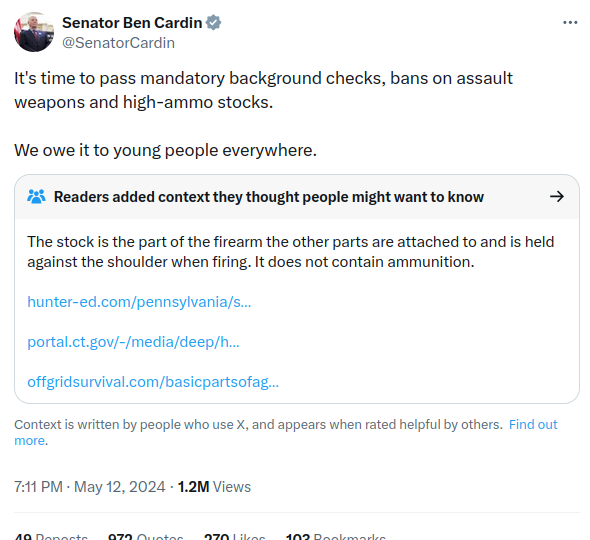
Confusing stocks and magazines? Stocks made of a bunch of cartridges? High-priced ammunition company exchange shares? Who knows? I had a brief impulse to contact Cardin’s office and ask what he was talking about, but…
The fact is, when you’re a tyrannical SOB who wants to regulate, control, or ban everything, it doesn’t really matter if you’re also an ignorant, tyrannical SOB.
As for “mandatory background checks,” sales through Federal Firearms Licensees already have mandatory background checks. And the ATF has already published a rule requiring anyone who might sell, or buy, a gun to be an FFL required to conduct “mandatory background checks.”
It’s almost enough to make me miss New York Congress-scum Major Owens, who at least had the honesty to file bills to simply repeal the Second Amendment outright.
That opening sentence explains much: a three judge (2 Dubya appointees, and a Trump appointee) panel, not en banc. I’ve no doubt that the state is preparing a motion for en banc review.
The decision, United States v. Duarte, is here. The majority based this ruling on BRUEN, with a dash of HELLER: there is no national “historical tradition of” barring felons who have completed their sentences from possessing firearms. Some readers may recall that such a bar never existed until the Gun Control Act of 1968, less than 50 years ago.
Almost two years ago, I pointed out that, “Much of the GCA ’68 is on very thin ice.”
The dissent, by Dubya appointee Judge Milan Smith Jr., is interesting in a morbid way.
The Supreme Court’s decision in New York State Rifle & Pistol Ass’n, Inc. v. Bruen, 597 U.S. 1 (2022), did not overrule Vongxay. Instead, Bruen reiterates that the Second Amendment right belongs only to law-abiding citizens.
That’s a two-fer. First, the referenced Vongxay is a 2010 Ninth Circuit opinion. Smith is asserting that d 2022 BRUEN, by the lowly Supreme Court of the United States — you know; that one above the Ninth — does not override the majestic Ninth’s precedent. His rationale is that BRUEN didn’t specifically mention and overturn Vongxay by name.
Mommy! Timmy won’t stop poking me!</i?
Stop poking your sister, Timmy.
Mommy, he’s poking me again!
Timmy! I told you stop that!
But that was when I poked her with my index finger. You didn’t say I couldn’t use my middle finger, Mama.
Second, BRUEN does not reiterate “that the Second Amendment right belongs only to law-abiding citizens.” On the contrary, in BRUEN Associate Justice Breyer, in his dissent admitted:
Founding-era legislatures did not strip felons of the right to bear arms simply because of their status as felons.
BRUEN determined that law-abiding people do have Second Amendment protected rights, but it does not specifically exclude convicted felons who have completed their sentences, and presumptively reformed and now law-abiding people, whom it’s also presumptively safe to let walk our streets.
Rather like recognizing the right of a convicted felon, who has completed his sentence, to vote.
The ATF’s rule redefining “engaged in the business,” and who must have a Federal Firearms License, has been released, but not yet formally published in the Federal Register. The Zelman Partisans has been warning you about this since 2022.
The rule document is 466 pages. Most of that is hundreds of pages of “responses” to public comment that amount to “We disagree,” and “tough shit.” The part where they claim that requiring everyone to have an FFL is BRUEN-compliant, because the feds briefly banned the export of cannons and gunpowder in 1794 is a classic.
Well, except for responses to the 250,000 identical form letter comments in favor of the rule. Those responses tend towards, “You’re absolutely right, and it’s a shame those stupid constitutionalists can’t see that.”
The actual final rule begins on page 452, and it’s even worse than the original proposed rule.
“Selling” a firearm includes swaps and barter, not just money.
A single transaction can make you a dealer, as I warned.
No firearm actually even needs to be sold. Whether the ATF thinks you intend to sell a firearm counts.
Buying a single firearm can make you a dealer, if the omniscient ATF magically foresees that you intend to resell it later.
It includes a presumption of guilt. If they accuse you, it’s up to you to prove — somehow — that, “No, I bought that for my own use; I’m not planning to sell it years down the road.” Good luck with that; if you win, you’ll still be bankrupted by legal expenses.
VP “Kneepads” Harris weighed in on the new rule. Sorta. With her usual display of her monumental intellect:
As the head of the first-ever White House Office of Gun Violence Prevention, I am proud to announce that all gun dealers must conduct background checks no matter where or how they sell.
This will save lives and keep our communities safe.
Poor confused moron. Dealers have been required to conduct background checks “no matter where or how they sell” for decades.
This rule simply forces universal preemptively-prove-your-innocence background checks by making everyone a dealer.
And while this unconstitutional action was directed by the Bipartisan Safer Communities Act, it would do nothing to make safer communities. Those dealing in black market and stolen firearms will simply ignore this rule; just as they have ignored the FFA for 85 years, and the Gun Control Act of 1968 for 55 years.
The only people who will be affected by this proposed rule are the honest folk, who would have to decide between following the criminals’ highly successful 85 year old example, or being compliant chumps.
Probably unintentionally, the Senate perfected version of SB727 appears to technically make it illegal to possess a firearm in a home school under some circumstances.
In SB 727 the definition of “home school as a school was moved and applied to ALL the statutes, not just sections 167.031 to 167.071 as it does currently.
That makes the dwelling in which a home school is conducted a “school” or “school building” and Chapter 571.030.1(10) makes it a felony to possess a loaded firearm in “any school.”
(10) Carries a firearm, whether loaded or unloaded, or any other weapon readily capable of lethal use into any school...
But is that definitive? Does “any school” really mean home schools?
571.030(1) is both a little more general and specific.
(1) Carries concealed upon or about his or her person a knife, a firearm, a blackjack or any other weapon readily capable of lethal use into any area where firearms are restricted under section 571.107;
That forbids carry in specified locations in 571.107. And what does that say?
10) Any higher education institution or elementary or secondary school facility…
So it looks like “any school” is a higher education institution (college/university), and elementary and secondary schools (high school). Home schools aren’t specifically called out, but maybe those are elementary schools. How are elementary and secondary schools defined?
In 160.011, elementary and high schools are very specifically defined as public schools only. This restrictive definition is maintained in SB 727 section 160.011, where we see that elementary and high schools (secondary) are defined as public schools, not the separately defined home schools.
That change in language, from statute-specific to all statutes is disturbing. But since firearm-specific laws still reference public schools only, I think a decent lawyer could successfully argue which carries precedence should someone make an issue of armed homeschoolers. In which case, 571.107(15), regarding any private property applies.
(15) Any private property whose owner has posted the premises as being off-limits to concealed firearms by means of one or more signs displayed in a conspicuous place of a minimum size of eleven inches by fourteen inches with the writing thereon in letters of not less than one inch.
But I find it unlikely that a 2A-respecting homeschooler is going to post his own property as gun-free.
I saw a video recently that just made me salivate. Nope, not a new recipe to try, but it is something sweet and yummy.
I myself try to avoid places that are posted No Concealed Weapons. Yes, I realize the point of carrying concealed is that people can’t tell, but I figure if you don’t want “my kind” there, well then I certainly won’t offend you with my money either. The other reason I try to avoid them is it seems to me that most of the mass attacks are in gun free zones. It seems those pesky criminals don’t obey the sign clearly posted against having a weapon in their “Gun Free Zone”.
or, if you prefer a musical version (what the heck, I’m in a whimsical mood)
I’ve never quite really understood why businesses are responsible for slips, trips and falls, too hot coffee or a burgler breaking in and being injured. Yes, businesses have been sued for all those things. I would stay those are things the business really couldn’t prevent in large. Yes, if the sidewalk or walkway in front of the store is icy and they stay open for business they should clear it. And probably most business owners would do that without being told as they know if a customer falls on their icy walkway they risk a lawsuit.
But when it comes to allowing concealed carry on premises they shrink back and clutch their pearls. I’ve asked a few business owners about that and they’ve said their insurance company insists on it, but they don’t agree with it. I had one jewelry store owner tell me he had no problem with me carrying in his store and he wished I would that way if something happened there would be two of us. I guess nobody wants to be hauled to the back of a store and shot huh?
So back to Georgia’s HB 1364, it doesn’t infringe on the property owners rights, all it says if you deprive someone of the right to defend themselves with the most effective tool, then you bear the responsibility for their safety as you’ve chosen to remove their right to defend themselves should something untoward happens. This would also include parking lots.
Here’s a snippet
(1) ‘Lawful weapons carrier’ shall have the same meaning as provided for in Code
Section 16-11-125.1.
‘Weapon’ shall have the same meaning as provided for in Code Section 16-11-125.1.
A person, business, or other entity that owns or legally controls a property and has the authority to prohibit weapons on such property, including, but not limited to, such authority provided by Code Section 16-11-127, assumes absolute custodial responsibility for the safety and defense of a lawful weapons carrier who is prohibited from carrying his or her weapon, including a concealed weapon, while on such property and any other property such lawful weapons carrier is required to traverse in order to store or retrieve such weapon.
The absolute custodial responsibility imposed upon the person, business, or other entity provided for in paragraph (1) of this subsection extends to the conduct of other invitees, trespassers, and employees of such person, business, or other entity.
Any public notice posted on a property that includes language which provides that weapons are prohibited on such property shall also contain language citing this Code section and providing that any lawful weapons carrier who is prohibited from carrying his or her weapon, including a concealed weapon, while on such property shall be under the absolute custodial care of the person, business, or other entity that owns or legally controls such property.
Any lawful weapons carrier who is prohibited from carrying his or her weapon,including a concealed weapon, and who is injured, suffers bodily injury or death, or incurs economic loss or expense, property damage, or any other compensable loss as the result of conduct of another person occurring on property where the lawful possession of weapons is prohibited, shall have a cause of action against the person, business, or other entity that owns or legally controls such property and causes such prohibition to occur.
In addition to damages, the lawful weapons carrier shall be entitled to reasonable attorney’s fees, expert witness costs, and other costs necessary to bring the cause of action.
To prevail in an action brought under this subsection, the plaintiff shall show by a preponderance of the evidence that:
(A) The plaintiff was a lawful weapons carrier at the time of the incident giving rise to the action;
The plaintiff was prohibited from carrying a weapon, including a concealed weapon, on the property where the incident occurred by the person, business, or other entity that owns or legally controls such property; and
Every time I think about gun free zones, I think about Suzanna Gratia Hupp’s poignant testimony before congress.
This is a bill I’ve wanted to see in my state for a long time. If it’s the insurance companies pulling the strings, then shop owners really aren’t making their own choice anyway are they?
The Supreme Court today heard oral arguments in Cargill v. Garland, the challenge to Trump’s (yeah, he still owns it) bump-stock ban.
Now, it’s true that we still have Clarence Thomas, who is intelligent and willing to study facts at issue. But we also have Associate Justice Ketanji Brown Jackson.
“And when, you know, ‘function’ is defined, it’s really not about the operation of the thing. It’s about what it can achieve, what it’s being used for. So I see Congress as putting function in this. The function of this trigger is to cause this kind of damage, 800 rounds a second or whatever.”
That was after the government claimed that a semiauto rifle with a bump-stock can fire 600 rounds per minute. But Brown, with firearm knowledge exceeding that of John Moses Browning, knows better: 800 rounds per second.
Probably theoretically, higher, once you account for those magazine changes in that one second.
Just for comparison, the GAU-8/A Avenger seven-barreled, Gatling-style autocannon in the A-10 attack aircraft — the beloved “Warthog” — has a measly rate of fire of just 3,900 rounds per minute; twelve times slower that Jackson’s magical bump-stocked gun.
But back to bitter reality. We’re stuck with ignorant high court judges, who when even the banners inflated claims fall short, simply make up their own “facts” to rationalize the infringement of allegedly protected rights.
Oh, well; however SCOTUS rules, Thomas’ takedown of Jackson’s idiocy should be amusing.
Jews. Guns. No compromise. No surrender.
Password Reset
Please enter your e-mail address. You will receive a new password via e-mail.