David Hardy, Of Arms and the Law, linked to a bizarre pro-gun control survey conducted by ValuePenguin/Lending Tree.
Hardy noted:
Reminds me of the DMI survey, commissioned by NRA-ILA at its birth. It found that, if you took the respondents who wanted more gun control and asked them what type they wanted, most of them would name measures that were already in federal law.
He’s right. I won’t bother with a complete fisk of the survey, but I will point out this chart of restriction survey respondents allegedly support.
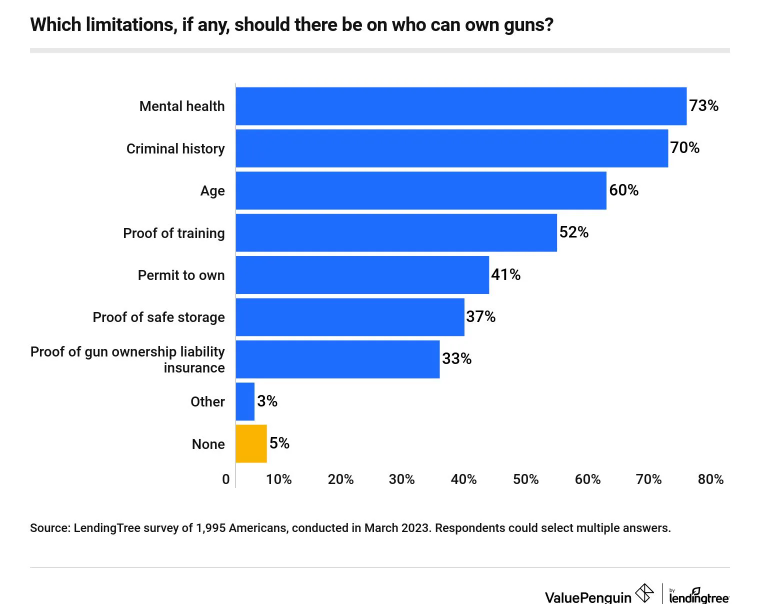
Yep, the top three (by far) restrictions are things currently restricted — heavily — at local, state, and federal levels. I’d like to see the actual questions. Did they ask if respondents want those, or did they ask if they want more of those? We won’t know because 1) there’s no link to the actual survey questions or raw data, and 2) the article has no contact data for the article writer or pollsters. I did find a general contact; I’ll see what response I can get out of it.
This part is interesting.
As mentioned, 75% of Americans favor requiring liability insurance for gun owners. In fact, support for liability insurance on guns is almost as high as support for liability insurance on homes (72%) or cars (84%).
Huh. 75% of Americans favor paying insurance companies more money, to exercise a Constitutionally-protected right. Kinda makes you wonder who they surveyed. I’ll “circle back” to that shortly.
You can see the “75%” (44 and 31) in this graph.
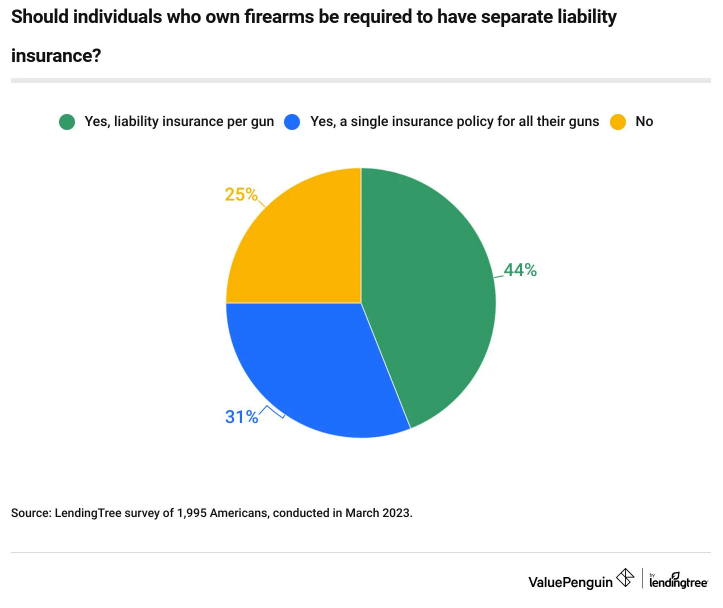
The problem is… go back to the first chart I posted and check the “Proof of gun ownership liability insurance” bar: that one says only 33% want that. Which is it, Lending Tree?
Who did they survey, and how? Since the survey data isn’t available, we’re stuck with this brief explanation of their methodology. The bold is my emphasis.
ValuePenguin commissioned Qualtrics to conduct an online survey of 1,995 U.S. consumers ages 18 to 77 from March 17 to 21, 2023. The survey was administered using a non-probability-based sample, and quotas were used to ensure the sample base represented the overall population. Researchers reviewed all responses for quality control.
Well, I’ll have to give them credit for some honesty. “Nonprobability sample”? They admit it? That’s pretty much a first for pro-gun control polling. (I mean, they do it, most just don’t admit it.)
If you’re confused, nonprobability sampling is…
Probability sampling, or random sampling, is a sampling technique in which the probability of getting any particular sample may be calculated. In cases where external validity is not of critical importance to the study’s goals or purpose, researchers might prefer to use nonprobability sampling. Nonprobability sampling does not meet this criterion. Nonprobability sampling techniques are not intended to be used to infer from the sample to the general population in statistical terms.
In layman-speak: Probabilty sampling is meant to gather — randomly — respondents that you hope will be represenative of the general population. Nonprobability sampling is for when you don’t actually care about the general population. You care about A) presenting a preconceived conclusion, B) only what certain people think, or C) both.
No wonder they didn’t care that their graphs conflict with each other. They were shooting for A) the preordained conclusion that more people want to pay more, and B) probably surveyed insurance company execs and salescritters (gotta keep those sales commissions and bonuses coming).
Gab Pay link (More Tip Jar Options) |