Category Archives: Courts

Presumed Guilt In NYC

Somehow, this isn’t at all surprising.

Breaking: Newly Leaked Documents Reveal NYPD Assume Carrying a Firearm Illegal Until Proven Otherwise Despite SCOTUS Ruling
The New York Police Department (NYPD) treats all instances of concealed carry as an illegal act until it can be proven otherwise, according to newly leaked documents obtained by Project Veritas.

New York is playing against a Supreme Court Ruling.

Specifically, they are playing again the very “specific” ruling in Bruen.

In keeping with Heller, we hold that when the Second Amendment’s plain text covers an individual’s conduct, the Constitution presumptively protects that conduct.

“Presumptively.” They don’t get to — legally — presume the conduct is unlawful. They — legally — must presume carry is lawful unless and until proven otherwise.

But what else would you expect of constitutionally and judicially ignorant scumbags who also ignored this part…

That said, respondents’ attempt to characterize New York’s proper-cause requirement as a “sensitive-place” law lacks merit because there is no historical basis for New York to effectively declare the island of Manhattan a “sensitive place” simply because it is crowded and protected generally by the New York City Police Department.

… to declare the city a “sensitive place” piecemeal.

It will soon be forbidden to carry a firearm, even concealed, in the famed Times Square district and other public places in the city and state of New York, authorities announced on Wednesday.

Can someone point me to a citation saying the Supreme Court cannot issue bench warrants for “supreme” contempt of court?


Carl is an unpaid TZP volunteer. If you found this post useful, please consider dropping something in his tip jar. He could really use the money, what with ISP bills, site hosting and SSL certificate, new 2021 model hip, and general life expenses.
Click here to donate via PayPal.

(More Tip Jar Options)
Facebooktwitterredditpinteresttumblrmail

It Begins

Bruen is rolling downhill to lower courts.

In California even. A state court.

The People of the State of California v. Tony Diaz. Diaz was busted for carrying an unregistered handgun without a license. The court cited Bruen and tossed the charges. The state is allowed to file an amended complaint, and — it being California — I assume they will.

At the time of defendant’s arrest California provided one legal means by which an individual could exercise their right to public carry- to get a license under section 26150. That path was unconstitutional. According to Shuttlesworth, faced with an unconstitutional restriction on his constitutional right, defendant was free to engage “with impunity in the exercise of the right. .. ”

The Court does not relish the conclusion reached here and understands its ramifications. But this result cannot be avoided in light of Bruen and Shuttlesworth and the arguments presented by the parties.

The demurrer is SUSTAINED. The People may attempt to remedy the complaint by filing an amended complaint within ten calendar days of the issuance of this order.(§ 1007.) If an amended complaint is not timely filed, the case will be dismissed.

When even California has to take note, we’ve started down the path to freedom again.


Carl is an unpaid TZP volunteer. If you found this post useful, please consider dropping something in his tip jar. He could really use the money, what with ISP bills, site hosting and SSL certificate, new 2021 model hip, and general life expenses.
Click here to donate via PayPal.

(More Tip Jar Options)
Facebooktwitterredditpinteresttumblrmail

Gun Courts And Constitutionality

I ran across an opinion column advocating for a ban of semiautomatic weapons — all of them; not just “assault weapons” — that raised the usual bogus points: The Second Amendment is not an individual right, the National Guard is the militia, no defensive usefulness, and so on.

I could address so many points in that column, but one truly stands above the others.

Why all semi-automatic weapons must be banned on a national basis
“The Constitution expressly allows Congress the right and authority to dictate the jurisdiction of the federal courts. To make sure the will of a majority of U.S. citizens are implemented, Congress could remove from the jurisdiction of the federal courts the ability to rule on the constitutionality of a ban of semi-automatic weapons (similar to the removal of jurisdiction over habeas corpus during the Civil War).”

The author, Bob Reid, is, according to the mini-bio, an attorney who has practiced for 46 years, working on “both state and federal constitutional issues.” That makes his bizarre claim even more incomprehensible.

I have studied the Constitution for decades but that provision still eludes me.

Article III, Section 1.
“The judicial Power of the United States, shall be vested in one supreme Court…”
Section 2.
“The judicial Power shall extend to all Cases, in Law and Equity, arising under this Constitution…” (emphasis added)

That would appear to assign jurisdiction over determinations of constitutionality to the courts. As for the suspension of habeas corpus as a pseudo-precedent for limiting the power of the Supreme Court, specifically delegated to the Courts by the Constitution…

Article I, Section 9
“The Privilege of the Writ of Habeas Corpus shall not be suspended, unless when in cases of rebellion or invasion the public Safety may require it.” (emphasis added)

Is Reid seriously proposing that Congress declare war (Article I, Section 8, Clause 11) on the people of the United States, as a means of suspending the Constitution?

And, frankly, citing Lincoln’s abuses of that suspension to imprison his judicial and press critics is bad enough; but the more recent suspension of habeas corpus used for the WW2 internment of thousands of Japanese-American families — including children — is hardly something I would use as justification for more constitutional abuses.

I wrote to Reid, to ask him to cite the constitutional provision which allows this proposed limitation on the Supreme Court. He surprised me by responding.

The Constitution lays out the original jurisdiction of the Supreme Court, but relegates to Congress the unrestricted right to create the judiciary under the Supreme Court, which it has done by creating District Courts and Courts of Appeal. Under this power, Congress can clearly dictate what kind of cases these lower courts can consider (and has exercised this power in the past). If the lower courts are not granted jurisdiction over certain subject matters, and the issue is not part of the Supreme Court’s original jurisdiction, the matter could not make its way to the Supreme Court.

He completely ignores the Article III assignment of jurisdiction for all federal courts, Supreme and inferior, and pretends to find it in the power to institute lower courts. I believe Mr. Reid, apparently primarily a tax attorney, is confusing Article I Tribunals with Article III Courts, and forgetting that tribunals are still “inferior to the supreme Court, just as Article III courts are “such inferior Courts.”

Tribunals are specialized “courts” that Congress can — and has — created for special limited purposes, “administrative courts” such as “tax court.” They are limited in their scope and power compared to Article III Courts.

In theory, Congress could create an ATF “gun court” tribunal responsible for ruling on GCA and NFA charges. But that tribunal — once again — is still “inferior to the Supreme Court” and its rulings would still be subject to Supreme Court review. That means The Supreme Court can still determine whether the tribunal’s acts, and the laws it enforces, are constitutional.

I hope Reid is better at tax law than he is at constitutional law.

He did have one other innovation for his ban; one that avoids the need for a few million door-kicking confiscators (and body bags for them).

These prohibitions should be coupled with a national buy-back program of semi-automatic weapons, but the refusal to sell these weapons or magazines to the government would not itself be a crime. Rather, if a crime is committed using a prohibited weapon or magazine, the owner or immediate seller of such a weapon or magazine would be equally liable for any crime committed with such weapon or magazine, regardless of who pulled the trigger.

So it’s a not a ban. But the criminal use of a semiauto would be a crime.

Hint, Mr.Reid. It already is.


Carl is an unpaid TZP volunteer. If you found this post useful, please consider dropping something in his tip jar. He could really use the money, what with ISP bills, site hosting and SSL certificate, new 2021 model hip, and general life expenses.
Click here to donate via PayPal.

(More Tip Jar Options)
Facebooktwitterredditpinteresttumblrmail

Prevailing Tyrants

If you are a gun owner in California, get out.

David Codrea pointed out something very interesting in California’s SB 1327. This is the new law allowing private parties to sue gun dealers and manufacturers.

This bill would create a private right of action for any person against any person who, within this state, (1) manufactures or causes to be manufactured, distributes, transports, or imports into the state, or causes to be distributed or transported or imported into the state, keeps for sale or offers or exposes for sale, or gives or lends any firearm lacking a serial number required by law, assault weapon, or .50 BMG rifle; (2) purchases, sells, offers to sell, or transfers ownership of any firearm precursor part that is not a federally regulated firearm precursor part; or (3) is a licensed firearms dealer and sells, supplies, delivers, or gives possession or control of a firearm to any person under 21 years of age, all subject to certain exceptions, as specified. The bill would make these provisions inoperative upon invalidation of a specified law in Texas, and would repeal its provisions on January 1 of the following year.

I’m sure you knew about that, but bad as it looks, it’s far worse. We begin with this.

1021.11. (a) Notwithstanding any other law, any person, including an entity, attorney, or law firm, who seeks declaratory or injunctive relief to prevent this state, a political subdivision, a governmental entity or public official in this state, or a person in this state from enforcing any statute, ordinance, rule, regulation, or any other type of law that regulates or restricts firearms, or that represents any litigant seeking that relief, is jointly and severally liable to pay the attorney’s fees and costs of the prevailing party.

That looks fairly standard: Loser pays winner’s legal expenses. But there’s a catch. If you challenge any state or local gun control law…

(e) Any person, including an entity, attorney, or law firm, who seeks declaratory or injunctive relief as described in subdivision (a), shall not be deemed a prevailing party under this section or any other provision of this chapter.

One more time: Any person, including an entity, attorney, or law firm, who seeks declaratory or injunctive relief from [any statute, ordinance, rule, regulation, or any other type of law that regulates or restricts firearms] shall not be deemed a prevailing party under this section or any other provision of this chapter.

They’ve preemptively declared themselves the winners. By law. In any challenge to any victim-disarmament law.

I’d be interested in hearing what more attorneys think. I’m fairly sure this violate the heck out of the First, Second, Sixth, and Seventh Amendments.

Added: I realized that I was assuming readers would understand some details. That may not always be the case, so I’ll break it down for those who don’t make a hobby of law.

Under this sickening provision, you could still challenge a victim-disarmament law. But, and it’s a big but, you cannot ask the judge for “declaratory or injunctive relief.”

“Declaratory or injunctive relief” means you’re asking the judge to declare that the law is clearly wrong (declaratory), or that it’s likely the law is wrong and temporarily halts enforcement while the trial is underway (injunctive). If you are challenging a magazine ban, for instance, you would want “declaratory or injunctive relief” because you don’t want to have to destroys your magazines while you wait to see if you win your suit (prevail). Of course you want relief.

But now, if you ask for it, you automatically lose, and you’re automatically on the hook for the government’s legal expenses. If you want to win, you cannot ask for a hold on enforcement. You’ll have to get rid of your magazines or face arrest, and buy replacements after you win your case.

Maybe mags are no big deal to you. But what if you were challenging a law that affected something more expensive? Maybe California banned your entire collection of three thousand dollar rifles? Give ’em up, if you want even a chance of “prevailing.”

That’s a hell of an up-front “legal expense,” or as Mark Smith outs it, a “poll tax.”


Carl is an unpaid TZP volunteer. If you found this post useful, please consider dropping something in his tip jar. He could really use the money, what with ISP bills, site hosting and SSL certificate, new 2021 model hip, and general life expenses.
Click here to donate via PayPal.

(More Tip Jar Options)
Facebooktwitterredditpinteresttumblrmail

Amicus Brief: Torcivia v. Suffolk County, NY

Via David Codrea, I saw this amicus brief for TORCIVIA v. SUFFOLK COUNTY. It’s an interesting case, for the sheer police-state thuggery involved. The brief summarizes the circumstances.

Try to keep your blood pressure under control.

The defendant police officers testified that Petitioner would “‘yell and scream,’” “‘explode,’” “‘start ranting and raving and screaming….’” Id. at 349-50. That testimony was contradicted by the fact that the Petitioner’s wife remained asleep in the house during the entire encounter with the police. Id. at 349 n.4.

At some point, the police handcuffed Petitioner, and transported him to a hospital for an emergency mental health evaluation, which demonstrated that he was neither a suicide risk nor a risk to others, and recommended he be discharged. Pet. Cert. at 10. Nevertheless, while Petitioner was at the hospital, officers learned from a computer check that Petitioner possessed a New York State pistol license. Id. at 9-10. Although both Petitioner and his wife refused multiple requests for the combination of the firearms safe to facilitate their seizure, eventually Petitioner was coerced by the threat of continued confinement until he provided the combination for his firearms safe. Id. at 11. Officers returned to Petitioner’s home and seized his firearms without a warrant. Id.

I found this part very interesting, for reasons not specific to this case; it’s more of an extension of the amicus argument.

This case represents a growing trend in the lower courts to reduce Fourth Amendment protections when firearms are involved. There is no basis for courts to create various types of firearms exceptions to the Fourth Amendment. It is well established that the exercise of one constitutional right cannot be conditioned upon the forfeiture of another constitutional right.

“It is well established that the exercise of one constitutional right cannot be conditioned upon the forfeiture of another constitutional right.”

the Second Circuit may not use Torvicia’s exercise of that constitutional right to render him vulnerable to government searches and seizures of his firearms which violate Fourth Amendment protections

You can’t violate his privacy and property rights because he chose to exercise his Second Amendment protected right.

And yet, New York already had, even before this unlawful and unconstitutional firearm confiscation.

The state violated Torcivia’s Fourth Amendment rights when they required him to register himself and his pistol before allowing him the “privilege” of exercising the right to keep and bear that pistol. How secure  are your “ persons, houses, papers, and effects” when you have to provide a list of them to the state in get permission to have them.

And this case shows exactly how dangerous forfeiting your privacy is: the state used that no longer private information to steal an innocent man’s property. Registering his exercise of the 2A did “render him vulnerable to government searches and seizures of his firearms.” Torcivia was not “secure” the instant he got a pistol license, and the state used that vulnerability against him.

Any one right does not exist in a vacuum. All constitutionally protected rights are fundamental and individual, and they interact. HELLER Established the the Second Amendment is an individual right. And from NYSRPA v. Bruen:

The exercise of other constitutional rights does not require individuals to demonstrate to government officers some special need. The Second Amendment right to carry arms in public for self defense is no different.

Second Amendment rights are no different than other rights… and Fourth Amendment rights are no different than the Second.

Licensing and registration force one to choose between giving up your constitutional Fourth Amendment right or surrendering your Second Amendment right. At your peril, either way.


Carl is an unpaid TZP volunteer. If you found this post useful, please consider dropping something in his tip jar. He could really use the money, what with ISP bills, site hosting and SSL certificate, new 2021 model hip, and general life expenses.
Click here to donate via PayPal.

(More Tip Jar Options)
Facebooktwitterredditpinteresttumblrmail

Dick Heller Is Suing DC Again

Over ammunition limits this time. From Heller’s filing:

25. Subsequently on March 6, 2015, the Chief issued a Notice Of Second Emergency And Proposed Rulemaking , N0051986, 62 DCR 2803, which without comment or explanation,doubled the allowable ammunition a concealed pistol licensee could carry on his person. This regulation read, “A person issued a concealed carry license by the Chief, while carrying the pistol,shall not carry more ammunition than is required to fully load the pistol twice, and in no event shall that amount be greater than twenty (20) rounds of ammunition.”

Yes, NYSRPA v. Bruen (seeing lots of these cases now) is cited.

There appears to be nothing in the text, history or tradition of the Second Amendment that supports limiting the amount of ammunition that a person may carry for his or her self-defense.

Upon seeing that, I immediately thought of the Militia Act of 1792, which actually specified a minimum amount of ammunition to be carried, not a maximum. And very much more than a single loading of the firearm (also required).

Sure enough, Heller knows that. As I continued reading, I saw this.

What regulations did exist around the time of the founding of the SecondAmendment required Americans to be armed as detailed above and required militia members to be equipped with aminimum amount of ammunition.

Here’s the relevant section of the Militia Act.

That every citizen, so enrolled and notified, shall, within six months thereafter, provide himself with a good musket or firelock, a sufficient bayonet and belt, two spare flints, and a knapsack, a pouch, with a box therein, to contain not less than twenty four cartridges, suited to the bore of his musket or firelock, each cartridge to contain a proper quantity of powder and ball; or with a good rifle, knapsack, shot-pouch, and powder-horn, twenty balls suited to the bore of his rifle, and a quarter of a pound of powder; and shall appear so armed, accoutred and provided, when called out to exercise or into service, except, that when called out on company days to exercise only, he may appear without a knapsack.

So the only historical and traditional precedent is for a minimum of 44 rounds; 2.2 times the arbitrary maximum that DC imposed. Or 22 times the amount needed to “fully load the [musket of the day] twice.”

[Correction: See comments below. That’s 24 cartridges if the militia had a musket, or 20 rounds if he had a rifle; not a total of 44. I apologize for misreading that.]

I rather hope this goes to the Supreme Court, since it provide a nationwide — not just the District of the District of Columbia — judicial precedent to argue against magazine limits (Hey, California…).

The DC District Court is going to hate this. It has generally been very supportive of DC’s rights-infringements, but NYSRPA v. Bruen is very, very clear.

Well done, Mr. Heller.


Carl is an unpaid TZP volunteer. If you found this post useful, please consider dropping something in his tip jar. He could really use the money, what with ISP bills, site hosting and SSL certificate, new 2021 model hip, and general life expenses.
Click here to donate via PayPal.

(More Tip Jar Options)
Facebooktwitterredditpinteresttumblrmail

Auto Key Card: Motion to Dismiss

Here’s another important Second Amendment case to watch.

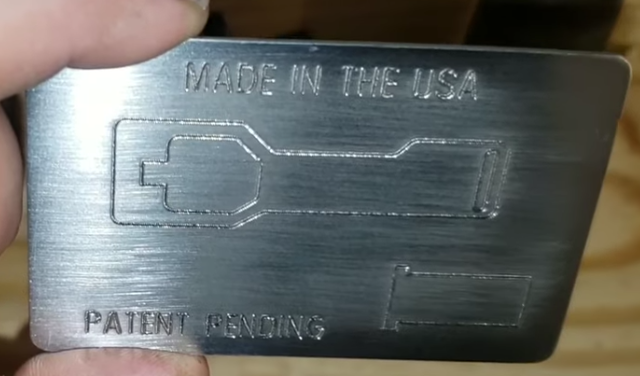
The case is US v. Matthew Raymond Hoover. Hoover was arrested and charged with an NFA violation; specifically that he was selling Auto Key Cards, pictures of parts that could be assembled into a “lightning link,” and subsequently installed in an AR-pattern rifle converting it into a machinegun. Others have been similarly charged for selling pictures.

Every news outlet that included pictures of the Auto Key Card in their reports should also be watching this case.

Hoover has moved to dismiss the charges in light of NYSRPA v. Bruen.

“[W]hen the Second Amendment’s plain text covers an individual’s conduct, the Constitution presumptively protects that conduct. The Government must then justify its regulation by demonstrating that it is consistent with the Nation’s historical tradition of firearms regulation. Only then may a court conclude that the individual’s conduct falls outside the Second Amendment’s ‘unqualified command.'”

Having explained the reasoning of NYSRPA v. Bruen to the court, they demonstrate the applicability to this case.

Further, the TAF’s decision that the tchothke at issue — a stainless steel card with some lines lightly thereupon engraved — was a machinegun came completely by administrative fiat, absent even notice and comment. Our Nation’s history and tradition does not, and cannot, support a finding that an alleged drawingof a part is that part merely because an elected bureaucrat unilaterally willed it to be.

I was just discussing this morning the fact that the NFA of 1934 was completely unprecedented in prior legislation. Because the applicability of NYSRPA v. Bruen to the NFA is extremely obvious.

However, since they mentioned an “elected bureaucrat unilaterally” usurping Congress to make their own “laws,” I would also have cited West Virginia v. EPA, in which the Supreme Court slapped down the EPA for doing exactly that.

I can’t see an honest court upholding these charges in view of NYSRPA v. Bruen. But we have a major problem with American courts, in that respect. So I won’t be terribly surprised if this ends up going to SCOTUS eventually. For a change, and elimination of federal bureaucratic power and abuse, as dramatic as tossing the NFA, this pretty much has to go the the Supremes.

Added: I almost missed it, but this is one of the Firearms Policy Coalition‘s cases. It’s another example of why I’ve long believed they deserve the support of those believe in the Second Amendment.


Carl is an unpaid TZP volunteer. If you found this post useful, please consider dropping something in his tip jar. He could really use the money, what with ISP bills, site hosting and SSL certificate, new 2021 model hip, and general life expenses.
Click here to donate via PayPal.

(More Tip Jar Options)
Facebooktwitterredditpinteresttumblrmail

SCOTUS Remands Remaining Second Amendment Cases

Today’s orders list is out. The Supreme Court granted certiorari for several 2A cases, vacated them, and remanded them back to the Circuit courts “further consideration in light of New York State Rifle & Pistol Assn., Inc. v. Bruen, 597 U. S. ___ (2022).”

Excellent! This is definitely the Court putting the Circuits on notice that they darned well better treat the Second as a fundamental constitutional right not subject to “compelling government interest” means testing. And we mean it this time!


Carl is an unpaid TZP volunteer. If you found this post useful, please consider dropping something in his tip jar. He could really use the money, what with ISP bills, site hosting and SSL certificate, new 2021 model hip, and general life expenses.
Click here to donate via PayPal.

(More Tip Jar Options)
Facebooktwitterredditpinteresttumblrmail

Reining In Bureaucrats

Yesterday, I wrote about West Virgina v. EPA, a case challenging the ability of EPA bureaucrats to write “law.” If the states won, the precedent would be great news for those challenging the ATF’s propensity for pretending to be Congress.

We won. In a 6-3 opinion, Roberts wrote:

Congress did not grant EPA in Section 111(d) of the Clean Air Act the authority to devise emissions caps based on the generation shifting approach the Agency took in the Clean Power Plan.
[…]
This is a major questions case. EPA claimed to discover an unheralded power representing a transformative expansion of its regulatory authority in the vague language of a long-extant, but rarely used, statute designed as a gap filler.
[…]
Given that precedent counsels skepticism toward EPA’s claim that Section 111 empowers it to devise carbon emissions caps based on a generation shifting approach, the Government must point to “clear congressional authorization” to regulate in that manner.
[…]
But the only question before the Court is more narrow: whether the “best system of emission reduction” identified by EPA in the Clean Power Plan was within the authority granted to the Agency in Section 111(d) of the Clean Air Act. For the reasons given, the answer is no.

The bump-fire stock ban, with its redefinition of “manual operation of the trigger comes immediately to mind.


Carl is an unpaid TZP volunteer. If you found this post useful, please consider dropping something in his tip jar. He could really use the money, what with ISP bills, site hosting and SSL certificate, new 2021 model hip, and general life expenses.
Click here to donate via PayPal.

(More Tip Jar Options)
Facebooktwitterredditpinteresttumblrmail

246 Years Of Slippery Slope Make A Great Power Source

Here’s a post from my personal blog. I wanted to share it with TZP readers. Imagine trying to explain GCA ’68, Brady Bill, Lautenberg Amendment, and the past week’s 2A shenanigans to James Madison.

246 Years Of Slippery Slope Make A Great Power Source
[…]
Have you ever been trolled and harassed on social media by some girl you dated? She’s a domestic violence offender. Twitter trolling is annoying, but it hardly seems worth depriving someone of her fundamental, constitutional, individual rights for life. Just block her.

Imagine James Madison hearing about what we’ve done to the Bill of Rights in the 21st century.

“You deprive citizens of their g-d-given right to arms for mean letters?”
[…]


Carl is an unpaid TZP volunteer. If you found this post useful, please consider dropping something in his tip jar. He could really use the money, what with ISP bills, site hosting and SSL certificate, new 2021 model hip, and general life expenses.
Click here to donate via PayPal.

(More Tip Jar Options)
Facebooktwitterredditpinteresttumblrmail