
A Childrens National doctor claims to have found that universal background checks reduce child firearms deaths by a whopping 35%. That’s rather astonishing.
State Gun Laws and Pediatric Firearm-Related Mortality
The presence of these laws was associated with a >35% lower rate of firearm-related mortality, even after adjustment for socioeconomic factors and gun ownership.
I was going to do an all-out analysis of this paper, since just from the press release I knew it had problems (cross-sectional analysis, without longitudinal; 18-21yo “children”), but this persuaded me to not waste that much time.
These data were used to select firearm-related deaths per year for those aged ≤21 years by state, except in states with <10 annual firearm-related deaths where the counts were suppressed.
Allow me to summarize: We compared death rates in states with gun control laws to state without, and found those states with the laws had fewer deaths once we tossed out the low death/no-law states.
You see, we can look up the states with the laws in question and see that their numbers of deaths exceeded the threshold for inclusion. Therefore, it had to be states without those laws that they tossed.
When I thought I was going to write all this up, I took a look at their supplemental information. Look at Table 5.
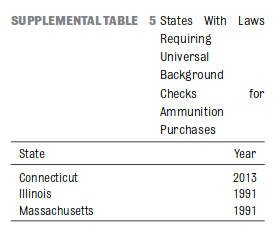 They confused a firearm owner identification card requirement for actual background checks on transactions.
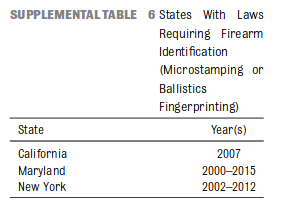 Table 6, and even the inclusion of a microstamping/ballistic fingerprinting law, was simply pointless. Maryland and New York gave up fingerprinting because it never worked (pro-tip: the average “time to crime” for a firearm is over ten years, by which time the rifling and firing pin have been changed by a decade of wear or replacement, so it’s useless). California’s microstamping law is even more pointless because no commercial gun has it (and would be subject to the same wear).
Oh. And they cited Kellerman.
-sigh-
So, starting with bad data, and excluding data that would invalidate their thesis, they did a cross-sectional comparison only, with no longitudinal analysis to find an effect of implementation of background check laws on in-state trends. A UC Davis study found no effect on homicide or suicide rates in the ten years after California’s passage of a universal background check law. More recently, California has seen an increase in firearms homicides.
The firearm homicide rate, which adjusts for population changes, increased by 15 percent from 2014 to 2016.
I can only speculate why they excluded 2016 and 2017, for which WISQARS data are available. Particularly since those years saw a 17.25% increase in 0-21yo firearms deaths over the 2011-2015.
And even so, a 35% decrease in fatalities seems odd, since approximately 96% of guns used in crimes were obtained through theft or trafficking, bypassing background checks; and at least 75% of murderers were prohibited persons due to felony convictions (60% alone), misdemeanor domestic violence convictions, rulings of mental illness, or court orders. Add in drug users (like this guy) and the percentage is even higher.
Just another BS paper with a pre-set agenda, lacking in anything resembling science.
[Permission to republish this article is granted so long as it is not edited and the author and The Zelman Partisans are credited.]
(More Tip Jar Options) |


