
The Epoch Times reports that the ATF’s Notice of Proposed Rule-Making on whether a stabilizing brace turns a pistol into a short-barreled rifle has been published in the Federal Register.
However, while they link a DOJ pre-published copy, and provide no link the NPRM on the Register. A search there does not turn it up, nor does it yet appeared on Regulations.gov. The document that ET links to even states that the text of what gets published may differ.
This one differs greatly from the ATF’s previous abortive attempt at rule-making on braces last year. The 2020 fiasco was purely subjective; We’ll know an SBR when we see one. This one at least makes the attempt to appear objective. They will create an evaluation worksheet, a “4999.”
The meat of the NPRM, the 4999, is a checklist, which assigns “points” to a braced firearm on a ranked basis. The more like a brace, the lower the points. More like a buttstock, more points. They would “evaluate” various characteristics. It’s broken down into two testing sections.
Starting with Section I, the firearm must weigh at least 64 ounces, but — as we’ll see — no more than 120 ounces. It must be at least 12 inches long, but no more than 26. If your brace meets those “prerequisites,” you get to proceed to the next part.
Section II looks at “accessory design,” “rear surface area,” “adjustability,” and “stabilizing support.”
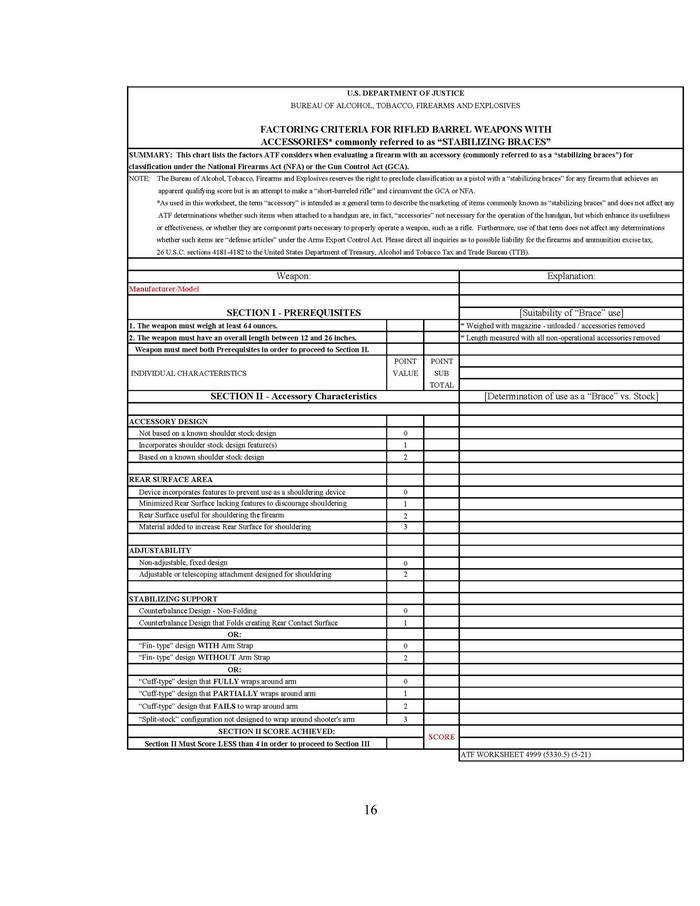
If the design accrues 4 or more points in Section II, do not pass go. It’s a short-barreled rifle.
Frankly, about the only design that would pre-qualify as a brace in Section II would be a nonadjustable (for length, one presumes) fabric arm loop/”cuff” with some feature like a rear point to make it specifically uncomfortable to shoulder. I really don’t wants points on a brace, and fixed length brace that’s fine for six-footer me probably won’t fit my four-foot, eleven inch sister.
Rear surface area? It’s purely an arbitrary guessimate by the examiner, No standard is given. Much of the “objective” process is like that.
The subject of “cuff” is interesting. That reminded me of part of my comment on the December NPRM, more reasonable definition of brace.
A device designed to aid a user in holding a large pistol with one hand, which extends no further than the user’s forearm when gripping the firearm normally, and which conforms to the user’s forearm.
Maybe they read it.
If we survived Section II, we get the privilege of advancing to Section III, where the evaluator looks at “length of pull,” “attachment method, “stabilizing brace modification/configuration,” and “peripheral accessories.” Again points are assigned on a sliding basis.

The only way not to get points for length of pull is for it to be less than ten and a half inches. If I were stabilizing an AR pistol, I’d want 13, which would earn me 3 points just on that. And note that even calling “length of pull” implies it’s an SBR unless proven otherwise.
For attachment method, most braced AR pistols I’ve seen would be safe, using a “standard AR-type pistol buffer tube.” Not all, though.
If one accepts that the ATF has any constitutional business regulating rifles, short-barreled or not (I don’t), the the mods/config section more or less makes sense.
The accessories test is bizarre. Some are consistent with other rules (no secondary forward vertical grip), but why the devil bureaucrat does putting flip-up iron sights (think for storage and transport) matter? That alone earns a point, of which you can have no more than 3. Four or more, SBR.
The proposed rule is a mess. It doesn’t allow for the possibility that someone might want to brace anything but an AR pistol. Even the only attachment method mentioned is the buffer tube. And what about this?

It might meet the minimum length prerequisite, but not the weight standard. Does that mean it is good to go, because it’s light, it cannot be an SBR? What about this one?

Or, because it’s light and attaches at other than the nonexistent buffer tube, it’s automatically an SBR? My definition would have settled it. The ATF’s doesn’t.
As usual, the ATF is an incoherent solution in search of a nonexistent problem.


