The Eighth Circuit has tossed the ATF’s pistol brace rule. The Court didn’t bother addressing the Administrative Procedures Act violations, because they found that another element of the challenge to the rule sufficed all by itself. The decision is thirty-three pages, but this one little excerpt pretty much summarizes it.
Thus, the Coalition is likely to succeed on the merits of its argument that this step is arbitrary and capricious; the ATF “has articulated no standard whatsoever for determining” when a stabilizing brace’s rear surface area would allow the shouldering of a weapon.
Huh; “arbitrary and capricious.” Where have I heard that before? Oh, yeah; in The Zelman Partisans’ original comment of the Notice of Proposed Rule-Making, more than three years ago.
This proposed rule is an incoherently expressed description of an arbitrary, capricious, and incoherent process of classifying firearms.
As no standards were given, a subjective examiner’s guesstimate of “rear surface area” could pass a brace, or put it right on the edge of alleged short-barreled rifle by itself. Will one examiner estimate the “rear surface area” of a cuff-type brace by the physical area of the rear EDGE of the cuff, while another goes by the area of the space ENCLOSED by the cuff?
We could have saved a lot of time and money if the ATF jackbooters had simply taken note of that at the time. But the ATF livesd for — and on — “arbitrary and capricious.” As backed up with Chevron deference, which the courts have also taken away from them.
No kidding. The Zelman Partisans noted that more than two years ago, when the Notice of Proposed Rule-Making was published.
This proposed rule is a coherently expressed description of an arbitrary, capricious, and incoherent process of classifying firearms.
As no standards were given, a subjective examiner’s guesstimate of “rear surface area” could pass a brace, or put it right on the edge of alleged short-barreled rifle by itself. Will one examiner estimate the “rear surface area” of a cuff-type brace by the physical area of the rear EDGE of the cuff, while another goes by the area of the space ENCLOSED by the cuff?
After the commenting period was over, the actual rule even worse than what was proposed. They tossed their proposed “checklist,” and switched to a list of arbitrary characteristics that went undefined; it was left up to each individual evaluator.
If you scroll down to page 268, you’ll find the actual final rule, and see that they opted for a evaluation system even more “arbitrary, capricious, and incoherent” than the 4999.
[…]
How much surface area does it take to create a rifle? The rule doesn’t say, leaving it up to “”arbitrary, capricious, and incoherent” FTB evaluators. Just think: the more firearms they can declare short-barrel rifles, the more tax money they can collect. No perverse incentive there, eh?
In short, braced pistol owners were left with two options to determine if their pistols had magically morphed into rifles: Send it to the ATF for individual determination, or wait to be arrested for possession of an unregistered short-barrel rifle.
This isn’t a final win. The Fifth Circuit panel only said that the rule is likely to be found to be unlawful. Based on that likelihood, they sent it back to the district court to reconsider an injunction against enforcement of the capricious rule.
I suspect this is going to bounce back and forth a while longer.
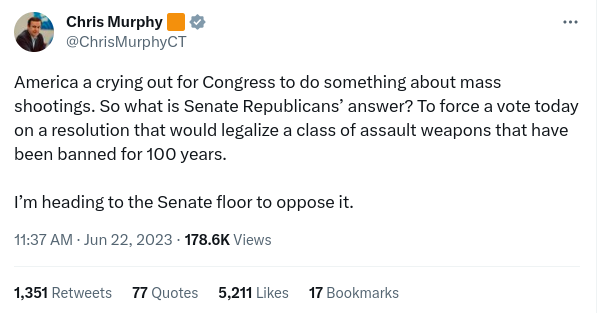
Connecticut Dimwit Senator Chris Murphy. Of course.
America a crying out for Congress to do something about mass shootings. So what is Senate Republicans’ answer? To force a vote today on a resolution that would legalize a class of assault weapons that have been banned for 100 years.
I’m heading to the Senate floor to oppose it.
Breitbart’s AWR Hawkins was a bit confused by Murphy’s tweet.
It is difficult to decipher Murphy’s tweet, as the Republican effort to block the ATF is about protecting guns with stabilizer braces that were legal to own without registration up until June 1, 2023.
What really confused him is that Murphy is simply dumber than a box of rocks.
Republicans were attempting to legislatively block the ATF’s pistol brace rule. That nonlegislative law-making declared braced pistols to be short-barrel rifles. Murphy, being stupid and ignorant — and apparently surrounded by equally incompetent staffers who couldn’t set him straight — seems to think short-barrel rifles are banned. They are not. Not even in Connecticut.
SBRs are regulated under the National Firearms Act; requiring the payment of a tax to lawfully possess. Murphy, had he two neurons to rub together, might have noticed that the ATF’s new, unconstitutional rule allowed a grace period for braced pistol owners to register their magically-turned-into-rifles pistols. I assume this regulation is what the idiot mistook for a ban.
Digression: I wouldn’t blame anyone who decided to use the ATF’s “amnesty” to register. It’s not a bad deal, given the regulatory environment we’re stuck with for now. But not for the reason the ATF thinks.
The ATF waived the registration tax. So you could register your braced pistol for free. And now that it’s a short-barrel rifle…
…you equip it with a real stock, and the barrel length of your choice. And now you have a real SBR ready to go, no charge. Transferable.
End digression
Possibly Hawkins was also confused by Murphy’s claim that this “ban” happened 100 years ago. Here’s a hint for the Connecticut cluck: the regualtion is through the National Firearms Act of 1934. That would be 89 years ago (minus a few days, as I type this); not 100.
Hawkins’ column mentions that these pistols were perfectly legal prior to the ATF arrogating Congress’ authority. And that raises an interesting point about the NFA and SBRs.
SBRs were regulated because Congress of the time considered them dangerously concealable. But pistols are even more concealable, yet not NFA regulated. The difference was how powerful a cut-down rifle is compared to a typical handgun. So there were really two factors that determined an SBR: barrel length and power.
But what was a pistol last month, and is now a rifle, still fires the same round. The brace doesn’t make it more powerful. It’s the same blasted gun.
I’d argue that this is one more indicator that the brace rule violates Congress’ intent. That might be an extra point to be raised in lawsuits challenging the rule.
Carl is an unpaid TZP volunteer. If you found this post useful, please consider dropping something in his tip jar. He could really use the money, what with ISP bills, site hosting and SSL certificate, new 2021 model hip, and general life expenses. Gab Pay link
(More Tip Jar Options)
Reminding gun owners what he did for the protection of the Second Amendment and pledging to do much more, former President Donald Trump closed the National Rifle Association’s main event Friday with a stemwinder that brought the crowd to its feet.
What he did for 2A protection? Lessee…
He did roll back a bizarre interpretation of 3D printer files as munitions (something that report falsely characterizes as “banning 3D-printed guns”). And he reversed the VA’s blatantly unconstitutional and illegal reporting of people to NICS. I’ll give him those.
On the other hand, he also signed Fix NICS, prompting states to arbitrarily convert more people into prohibited persons and felons.
And there was that Ninth Circuit Court of Appeals appointee who thinks, “the Second Amendment has no application to state laws.” What could possibly go wrong?
Even more damaging, he magically turned inert pieces plastic into machineguns, by executive fiat. That did more damage to 2A-protected rights than any Dim president had managed in decades. Estimates vary, but turned tens to hundreds of thousands of people into unindicted felons. And more than a few indicted and convicted.
Stroke of the pen, law of the land. Kinda cool. Well, Trump did used to be a Dimocrat.
He established the precedent that federal bureaucrats are free to redefine words at will, without enabling legislation, to call any damned thing they want “machineguns.” And the ATF immediately ran with it; they live for this… excrement.
The Rare Breed Triggers FRT-15 trigger group, which requires the trigger be pulled for each round fired, suddenly became a “machinegun,” by using the exact same “logic” of “operation of operation of the trigger” really meaning “volitional movement of the finger. Oops; more newly-minted felons.
On a roll with redefining words, they came for pictures. Yep, thanks to Trump’s precedent, the ATF decided that line drawings of unassembled pieces of lightning links really are machineguns. A couple of folks are on trial for that even now, including a guy who let people run ads for the Auto Keycard, but never even sold them himself.
The Trump precedential damage continued with braced pistols becoming short-barrel rifles, after they specifically were not. But at least they gave you the options of begging permission to pay for the privilege of keeping them, or self-incriminating and hoping they’d make an exception for you. More felons.
And he’s “pledging to do much more?” While didn’t act on them before, Trump has supported no-due process red flag orders, raising the age to buy any firearm to 21, and an “assault weapon” ban. Is that the “more” he’s promising? If the Dims were paying attention, they’d nominate Trump themselves over Xiden.
On the bright side, Trump’s Supreme Court picks might… might eventually repair the damage he did to the Second Amendment. But his actions will still cost us millions of dollars in legal expenses, endless man hours, and hard work — not to mention the harm done to plaintiffs and improperly charged defendants — to get the Court to reverse him. (And note that the brilliant BRUEN decision was not written by a Trump appointee.)
If it were just his SCOTUS picks, economic work, and the incredible Abraham Accords, I’d be happy to see Trump elected again. But the man has zero impulse control on Second Amendment issues; he can demonstrably be panicked into rash action by any high profile incident.
And we have to live with his impulses.
Carl is an unpaid TZP volunteer. If you found this post useful, please consider dropping something in his tip jar. He could really use the money, what with ISP bills, site hosting and SSL certificate, new 2021 model hip, and general life expenses. Gab Pay link
(More Tip Jar Options)
It’s probably worth noting that the ATF’s pistol brace rule was formally published in the Federal Register today, making it official.
The countdown has started. If you have a braced pistol, you have 120 days to decide how to proceed.
You may have heard that those attempting to register braced firearms as short-barrel rifles, may have an issue. Some claimed that if the form isn’t processed in 88 days, then it’s automatically denied. A more cogent explanation clarifies that.
When you apply for your tax stamp, the ATF goes to the FBI’s NICS for a background check. Unlike a firearm sale, which can proceed if the NICS check doesn’t come back in three days, at 88 days without a NICS response, the application is denied. It’s then up to you to go to the FBI and ask “What the heck’s going on with my background check?” and resubmit your stamp application.
Carl is an unpaid TZP volunteer. If you found this post useful, please consider dropping something in his tip jar. He could really use the money, what with ISP bills, site hosting and SSL certificate, new 2021 model hip, and general life expenses. Gab Pay link
(More Tip Jar Options)
The ATF’s final rule on whether pistol braces magically turn pistols into short-barreled rifles was signed on January 13, 2023.
Most of the document is rationalization of why they believe they can get away with this, and explaining away NPRM commenters’ objections. They did agree that the proposed form 4999 — which used an arbitrary point system to differentiate between pistols and short-barrel rifles — was flawed. They decided that was sufficiently flawed that they abandoned it.
Nothing in the Supreme Court’s recent decision in New York State Rifle & Pistol Ass’n v. Bruen, 142 S. Ct. 2111 (2022), changes this analysis. See id at 2162 (Kavanaugh, J. concurring) (reiterating Heller’s finding that “dangerous and
unusual weapons” are outside of the Second Amendment’s protections).
That presupposes that braces inherently make a perfectly acceptable firearm into a “dangerous” device without actually changing the firearm’s function. It assumes that “1.4 million” braced pistols (the ATF’s own estimate of the number extant) are “unusual.” It also completely ignores the “general historical tradition” test laid out in the main decision.
If you scroll down to page 268, you’ll find the actual final rule, and see that they opted for a evaluation system even more “arbitrary, capricious, and incoherent” than the 4999.
The short form now is that a firearm with a pistol brace is a short-barrel rifled if it is:
“a weapon that is equipped with an accessory, component, or other rearward attachment (e.g., a “stabilizing brace”) that provides surface area that allows the weapon to be fired from the shoulder”
How much surface area does it take to create a rifle? The rule doesn’t say, leaving it up to “”arbitrary, capricious, and incoherent” FTB evaluators. Just think: the more firearms they can declare short-barrel rifles, the more tax money they can collect. No perverse incentive there, eh?
And has arbitrary “other factors,” which are:
“a weight or length consistent with the weight or length of similarly designed rifles”
In a saner world, I could almost let that one slide.
“s a length of pull […] consistent with similarly designed rifles”
Length of pull, as The Zelman Partisans has noted, “presupposes that all braced pistols are SBRs until proven otherwise.” Guilty and taxable until proven innocent. It is the ATF after all.
“equipped with sights or a scope with eye relief that require the weapon to be fired from the shoulder in order to be used as designed”
That one is also almost reasonable, if it weren’t for the rest of the BS.
“Whether the surface area that allows the weapon to be fired from the shoulder is created by a buffer tube, receiver extension, or any other accessory, component, or other rearward attachment that is necessary for the cycle of operation”
Since “surface area” is purely arbitrary and undefined, I don’t see how this clarifies anything. But just wait…
“manufacturer’s direct and indirect marketing and promotional materials”
Now company advertising flacks can inadvertently turn pistols into rifles, and it has nothing to do with the physical characteristics of the firearm or brace. It gets worse, though…
“the likely use of the weapon in the general community.”
If the brace has some undefined amount of surface area, the ATF can still declare anything a short-barrel rifle simply by deciding that it’s likely some idiot somewhere will use his firearm incorrectly.
We would have been better off with the 4999, which at least didn’t test advertising fliers and ATF agents’ purported precognitive powers.
The rule gives those currently in possession of braced firearms a few options.
Send it to the ATF for evaluation, so see if it can make ot past the magic test and remain a pistol.
Destroy the firearm.
Remove the brace and destroy that.
Replace the firearm barrel with a 16 inch (or more) barrel.
Turn the firearm in to law enforcement or the ATF.
Go to prison on an NFA violation even if you have a letter from the ATF saying your braced pistol isn’t a rifle.
Or you can apply to register it. If you do so through the E-Form system within 120 days of the rules Federal Register publication, the ATF will generously waive the usual tax stamp fee.
Carl is an unpaid TZP volunteer. If you found this post useful, please consider dropping something in his tip jar. He could really use the money, what with ISP bills, site hosting and SSL certificate, new 2021 model hip, and general life expenses. Gab Pay link
(More Tip Jar Options)
The Machine Gun Nest has pieced together all the elements of a potential semiautomatic rifle ban in 2021. They have discovered the dangerous precedent of allowing the ATF to redefine words to make inanimate bits of plastic into machineguns, paperweights into firearms, and pistols into rifles. Why, all this adds up to making semiautos into machineguns because they’re easily converted.
“What’s going on with gun control right now in 2021?
There’s been much talk at the range recently about the new proposed gun control by the Biden Administration. Many people are perplexed. We get a ton of questions, emails, and phone calls asking, “Will this affect me?”, “What can I do?”, “Why are they doing this?” among others.
[…]
So, where does this all come together?
It’s obvious when you look at what’s happened and what’s been proposed where the Biden admin is headed for gun control. They are testing the waters right now with these two proposed rule changes, but I guarantee this is not the end. These current ideas have been taken right from the David Chipman “Legal and Lethal” playbook. There’s a part where Chipman writes this about semi-automatic rifles
Well, no sh-t, Sherlock. TZP has been warning about this specifically for nearly fours years. We warned about this before the ATF even proposed the bump-fire stock machinegun rule.
We warned you again two years ago, when that very “easily converted” argument was made in court. We warened you repeatedly.
We warned you in 2018 that easily converted to a higher rate of fire would define “machinegun.”
“What’s going on in 2021” maybe wouldn’t have been such a problem if more people had paid attention to what was going on in 2017, 2018, 2019, and 2020. More attention than ridiculing those of us warning about “Bump Stock Hill” anyway.
Speaking only for myself as an individual: There have been many days in recent years when I seriously questioned why I bother with trying to raise awareness of these dangers. This is one of those days. My work seems pretty pointless.
The Epoch Times reports that the ATF’s Notice of Proposed Rule-Making on whether a stabilizing brace turns a pistol into a short-barreled rifle has been published in the Federal Register.
However, while they link a DOJ pre-published copy, and provide no link the NPRM on the Register. A search there does not turn it up, nor does it yet appeared on Regulations.gov. The document that ET links to even states that the text of what gets published may differ.
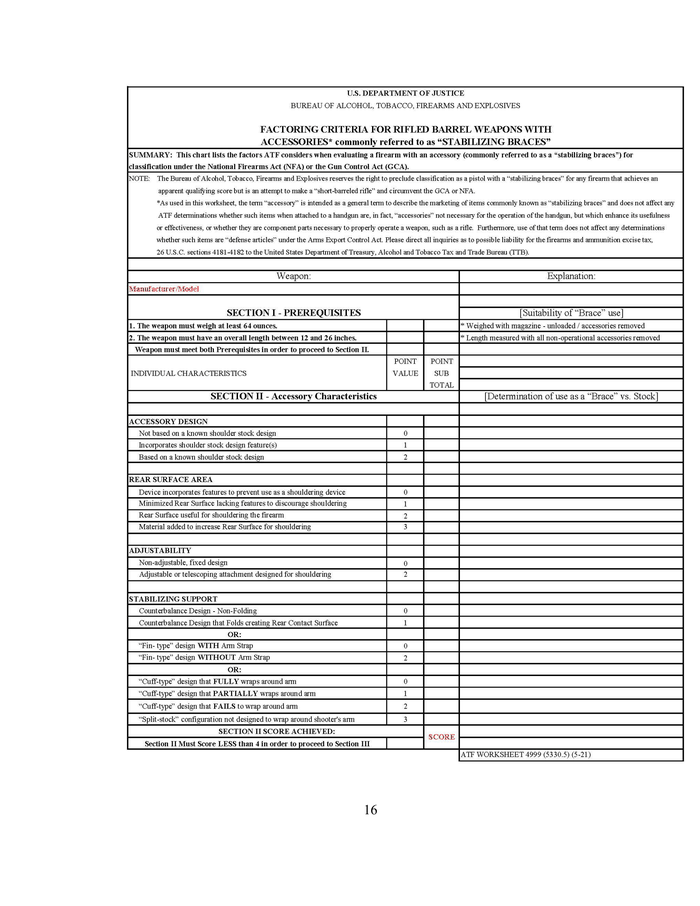
This one differs greatly from the ATF’s previous abortive attempt at rule-making on braces last year. The 2020 fiasco was purely subjective; We’ll know an SBR when we see one. This one at least makes the attempt to appear objective. They will create an evaluation worksheet, a “4999.”
The meat of the NPRM, the 4999, is a checklist, which assigns “points” to a braced firearm on a ranked basis. The more like a brace, the lower the points. More like a buttstock, more points. They would “evaluate” various characteristics. It’s broken down into two testing sections.
Starting with Section I, the firearm must weigh at least 64 ounces, but — as we’ll see — no more than 120 ounces. It must be at least 12 inches long, but no more than 26. If your brace meets those “prerequisites,” you get to proceed to the next part.
Section II looks at “accessory design,” “rear surface area,” “adjustability,” and “stabilizing support.”
If the design accrues 4 or more points in Section II, do not pass go. It’s a short-barreled rifle.
Frankly, about the only design that would pre-qualify as a brace in Section II would be a nonadjustable (for length, one presumes) fabric arm loop/”cuff” with some feature like a rear point to make it specifically uncomfortable to shoulder. I really don’t wants points on a brace, and fixed length brace that’s fine for six-footer me probably won’t fit my four-foot, eleven inch sister.
Rear surface area? It’s purely an arbitrary guessimate by the examiner, No standard is given. Much of the “objective” process is like that.
The subject of “cuff” is interesting. That reminded me of part of my comment on the December NPRM, more reasonable definition of brace.
A device designed to aid a user in holding a large pistol with one hand, which extends no further than the user’s forearm when gripping the firearm normally, and which conforms to the user’s forearm.
Maybe they read it.
If we survived Section II, we get the privilege of advancing to Section III, where the evaluator looks at “length of pull,” “attachment method, “stabilizing brace modification/configuration,” and “peripheral accessories.” Again points are assigned on a sliding basis.
The only way not to get points for length of pull is for it to be less than ten and a half inches. If I were stabilizing an AR pistol, I’d want 13, which would earn me 3 points just on that. And note that even calling “length of pull” implies it’s an SBR unless proven otherwise.
For attachment method, most braced AR pistols I’ve seen would be safe, using a “standard AR-type pistol buffer tube.” Not all, though.
If one accepts that the ATF has any constitutional business regulating rifles, short-barreled or not (I don’t), the the mods/config section more or less makes sense.
The accessories test is bizarre. Some are consistent with other rules (no secondary forward vertical grip), but why the devilbureaucrat does putting flip-up iron sights (think for storage and transport) matter? That alone earns a point, of which you can have no more than 3. Four or more, SBR.
The proposed rule is a mess. It doesn’t allow for the possibility that someone might want to brace anything but an AR pistol. Even the only attachment method mentioned is the buffer tube. And what about this?
That’s right out.
It might meet the minimum length prerequisite, but not the weight standard. Does that mean it is good to go, because it’s light, it cannot be an SBR? What about this one?
Good to go?
Or, because it’s light and attaches at other than the nonexistent buffer tube, it’s automatically an SBR? My definition would have settled it. The ATF’s doesn’t.
As usual, the ATF is an incoherent solution in search of a nonexistent problem.
Jews. Guns. No compromise. No surrender.
Password Reset
Please enter your e-mail address. You will receive a new password via e-mail.